Ask The Lawyers: Can parking management be held liable for fire and other incidents?

Testing the fine print
Management cannot be held liable for any damage to or loss of your vehicle.
Management will not accept responsibility for the loss or damage to any personal belongings left unattended on these premises.
Car parked at owner’s risk.
Those are phrases that we are all familiar with whenever we get a ticket from the box office at any parking facility in the country. It’s nothing new, but we’ve always wondered if it's going to be enforceable in any way.
Well, these words may be put to the test very soon.
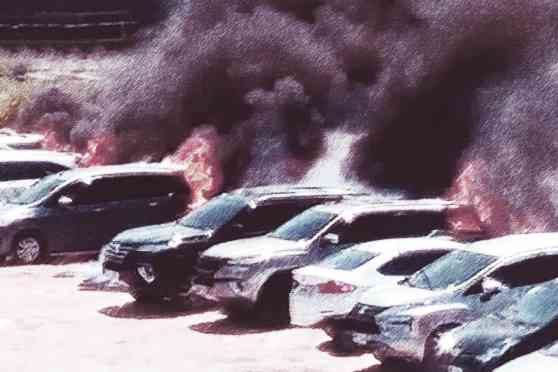
Just yesterday a huge fire happened in a parking facility next to Terminal 3 in the Ninoy Aquino International Airport (NAIA T3) complex. There are three parking facilities at NAIA T3: a paved facility in front of the terminal building, a multi-level parking (MLP) attached to the terminal, as well as a grassy open ground on the opposite side. It is on the open ground parking lot where the fire incident happened.
Given the proximity to an airport which is always prepared to respond to any aviation fire, the flames were rapidly snuffed out. It took the Manila International Airport Authority (MIAA) Rescue and Firefighting Division (RFD) and other responding firefighters 29 minutes to declare fire out from when they got the call at 1:28 PM.
No people were harmed, but 19 cars were gutted according to the official count. The initial reports and quotes from officials point towards a grass fire.
As a frequent parker at NAIA T1, T2, and T3 for my travels, this is concerning. I have parked my car for several days at all of those terminals, and have never experienced any problems. At that specific open ground, I chose not to park because it was unpaved, dry, and dusty; not exactly worth the PHP 300+ fee for every 24 hours my car stays there.
The operation of that specific parking lot is actually on a concessionaire basis just like any of the stalls or restaurants inside the terminal. They were quick to respond with a statement that says “they will shoulder all damages incurred by the owners of the vehicles” but are careful to state that it “shall not serve as an admission of fault or negligence” on their part.
The statement was a very carefully crafted one, and it seems that this is a case of an unfortunate incident but all’s well that ends well. But still, we have to ask our lawyer friends: In any future incident where parking management isn’t so forthcoming, or are even lot owners be held liable for such an incident?
Atty. Nath (last name withheld) who works as legal counsel for a government department stated that concessionaires can be held liable because of warranties, safeties, and the like. She says there are considerations like what started the fire, contributory negligence, and the extent of the damage caused to other cars before help started.
More importantly, she is of the opinion that the management-will-not-be-held-liable statement will not hold up in court because of the warranties. “If may negligence on the part of the staff which is always easy to prove, wala naman yan,” said Atty. Nath.
We consulted another lawyer: Atty. Allan who works in corporate, but specifically on the legal compliance side of things. He should be able to give an insight from a concessionaire or corporate perspective.
“Normally, the terms of a contract (here, yung parking slip containing terms) is the law between the parties,” said Atty. Allan, referring to the parking slip. “That is [the] contract containing terms, leaving one party with no other recourse than to accept the fine print. But the exception is what is known as contracts of adhesion.”
“While the general rule is that a party adhering to such contracts of adhesion are bound by the terms, our courts recognize that in such contracts of adhesion, one party is usually at a disadvantage and in certain instances will step in and protect the other party,” said Atty. Allan.
Before I could even message him, Atty. DJ Jimenez already shared his thoughts on his Facebook page (Pinoy Street Lawyer) and cited a preceding case. It reads:
Article 1174 of the Civil Code of the Philippines defines fortuitous events as those which could not be foreseen, or which foreseen, were inevitable. The law further provides that no person shall be responsible for such fortuitous events and exempts from liability the person obliged to do or perform something.
The above however is merely the general rule.
When human intervention or negligence sets in, the act of God is humanized and becomes an act of man. Thus, liability against those responsible sets in.
In the 2020 case of "MAXIMO AWAYAN v. SULU RESOURCES DEVELOPMENT CORP." G.R. No. 200474, November 09, 2020, the Supreme Court through J. Leonen reiterated the following: "When the event is found to be partly the result of a party's participation—whether by active intervention, neglect, or failure to act—the incident is humanized and removed from the ambit of force majeure. Hence, there must be no human intervention that caused or aggravated the event, or at the very least, it must be beyond the obligor's will."
Guided by the foregoing, if those responsible in maintaining the parking area is found to have failed on its duty to ensure that that fire hazards are removed to prevent similar incidents, then liability for the damages is as clear as the sun.
I find his point very interesting because it reminds me of an incident with a former boss/mentor wherein he drove a very expensive loaner SUV amidst a storm and a flood, and the vehicle was destroyed because of water ingestion. The fortunate part is that the insurance does not cover force majeure or Acts of God, but it does cover human negligence. By driving it through the flood negligently, the car became covered by insurance.
We sent the opinion of Atty. Jimenez to Atty. Allan who gave his own inputs: “Ah, this is the fortuitous event/force majeure angle naman. This is really a factual matter and will depend on the evidence submitted to the court. So here the findings of the BFP will be material. But this line of argument admits that the parking management assumes responsibility for the loss, except that the loss here was the result of a fortuitous event.”
If the parking management hadn’t been so forthcoming to support the owners (thankfully they were), the conversation would have been very different. Atty Allan says that in such a case, “the parking management will claim (1) contractually not liable, and (2) assuming the court finds the contract adhesion to be unduly disadvantageous to the car owners, that the loss was the result of fortuitous events.”
The key term will be “fortuitous event” as it is “by definition is something not foreseeable AND not avoidable.” And given that we are in the midst of an intense summer and extremely dry season, fortuitous might be a difficult thing to argue when it comes to a fire. We only need to listen for the frequency of responding firetrucks driving past us at speed.
There has been a parking regulation bill that is being pushed by the legislative that aims to manage the pricing as well as remove the disclaimer that parking operators have. Said bill is stalled now as far as we can remember. The only reasonable thing to do is to ensure that parking facilities and car owners have good insurance coverage. There will always be some kind of incident, and the responsible thing to do is to have good coverage.