2026 Ford Territory HEV: Better late than never?

What we liked (and didn’t like) with the 2026 Ford Territory Hybrid
We're used to Ford being the gamechangers and innovators. We've seen it in the Ranger, the EcoSport, and even with small turbocharged EcoBoost engines and dual-clutch gearboxes (even though the transmission didn't work out so well). But in the last year or two, they've been caught napping. A lot of their great models have seen some decline in sales, as well as in quality, like the Ford Explorer.
The Blue Oval anchored itself in the Philippines on three key models: the Thai-made Everest, the Thai-made Ranger, and the Chinese/JMC-made Territory. That was until BYD showed up and caught the Territory by surprise.
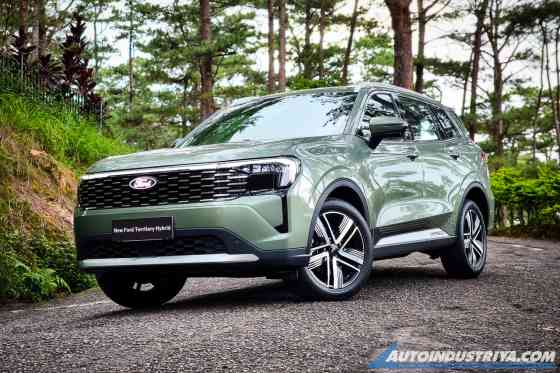
The success of the Sealion 6 really hit the Territory hard, so much so that sales of Ford's compact crossover slowed down significantly. The turbocharged Territory facing the BYD Sealion 6 PHEV proved to be too much. They needed something new to succeed in the compact crossover market.
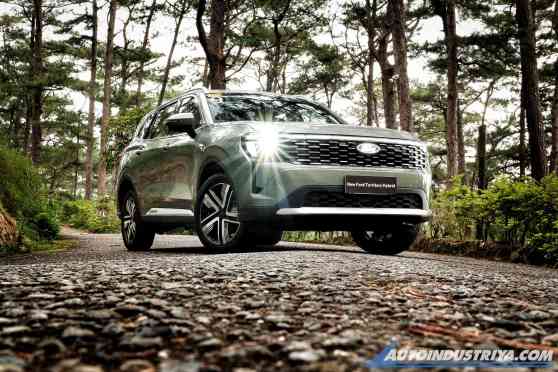
That's where the Ford Territory Hybrid comes in. They're not saying it, but we see it: this is their answer to the BYD Sealion 6. The only question is whether the Territory HEV can actually do it. So we thought we'd join them for a drive to the City of Pines in the new top-of-the-line Territory Hybrid Titanium X.
Hybrid Boost
The Territory Hybrid is different from what it's trying to compete against. While we initially thought Ford Philippines planned on bringing the PHEV version of the new Territory, we were surprised that they brought the hybrid electric vehicle (HEV) variant instead. It's actually a bit experimental for Ford. In China, the hybrid offering of the Territory (under JMC) is a PHEV. So in effect, the launch of the Territory non-plugin HEV is technically a global reveal. Strange, but that's what they did.
The look has changed, but we're more interested in its beating heart. The 1.5L turbocharged engine now runs on the Miller cycle. It is geared towards recharging a liquid-cooled 1.83 kWh lithium-ion battery pack and providing some assistance to the electric motor when needed. The engine alone makes 150 PS with 230 Nm of torque, while the electric motor produces 218 PS and a healthy 315 Nm of pulling power. Instead of a dual-clutch gearbox, the Territory Hybrid features a two-speed dedicated hybrid transmission (DHT) designed for optimal efficiency while cruising and delivering maximum power when needed.
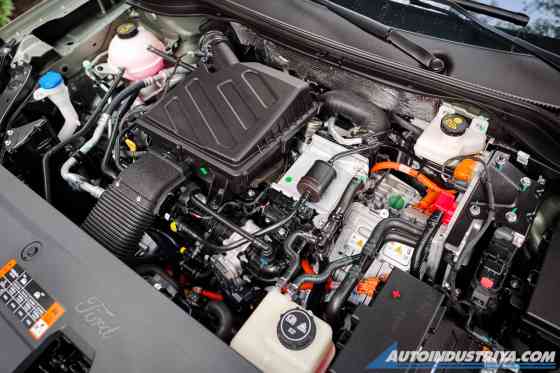
Yes, it still has a turbocharged engine under the hood, but it’s been tailored for a more efficient yet powerful drive. It’s also unlike your typical parallel hybrid system as Ford opted for an intelligent powertrain that switches from series & parallel hybrid modes, as well as the ability to run on full electric mode at certain speeds.
The hybrid system can seamlessly switch between various electrified modes like EV, Series, Parallel, and Energy Recovery on the fly. While this takes away some control from the driver, the system is smart enough to know which mode to pick without experiencing a hiccup. It’s also simpler and more manageable since the system powers a self-charging hybrid.
Fuel Sipper
Despite not having a plug-in hybrid system like its closest rival (the BYD Sealion 6), that doesn’t mean it’s not fuel-efficient. From the moment we left Ayala Malls Manila Bay and reached Rosario, La Union, via Skyway, NLEX, SCTEX, and TPLEX, we were able to average 17.9 km/L. That’s through mixed driving conditions in the city, some bit of traffic, and highway driving altogether. Heck, I was able to push its fuel efficiency up to 18.9 km/L without even trying under the best conditions along TPLEX.
This was made possible thanks to regenerative braking whenever the Territory Hybrid coasts or goes down steep hills. With a fully charged battery, I was also able to run on electric power at speeds of up to 50 km/h, or so Ford says. That’s because you can actually run on EV power for several seconds at speeds greater than 50 km/h. I was able to do this whenever I eased off my foot from the accelerator pedal and allowed regenerative braking to do its work. Afterwards, I gently step on the accelerator once more, but only just in order to maintain forward momentum and gain a little bit of speed without restarting the engine.
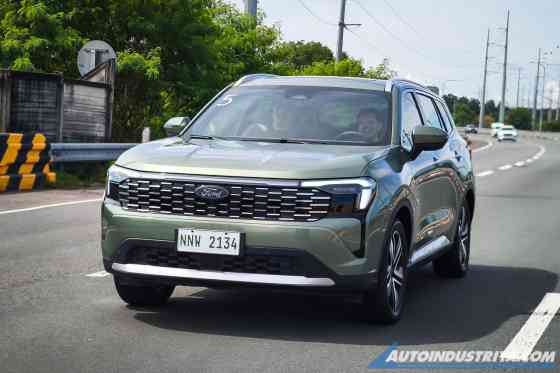
Once you apply more power (20% of energy or more, to be exact, based on the digital cluster), the engine kicks back in, and the system runs in Parallel mode once more. It may not be much, but the fact that you can do this EV trick in certain driving conditions means you can get more range and save on fuel while driving on the highway. What it lacks in a plug-in hybrid setup, it makes up for in ingenuity and clever energy recovery.
Speaking of energy recovery, we were able to quickly top up the battery on our way home when we took Asin Road. Since we were going downhill most of the way, I set the transmission to L (Low Mode) in order to make full use of regenerative braking. Since the electric motor was helping the vehicle slow down, I was also able to avoid using the brakes in certain parts, which helps prevent brake fade when going down. Moreover, I was able to average up to 19.2 km/L all the way down and only used a fraction of the fuel.
Torque Machine
HEVs are known for having plenty of torque on demand, and the Territory Hybrid is no exception. With the electric motor doing most of the work while the engine is there to assist when driving, there’s no delay whatsoever when you step on the accelerator and actually feel the torque as you generate speed. Set the drive mode to Sport and the system practically keeps the electric motor at its quickest response, which gives it sports car-like acceleration.
This was especially useful when we climbed Kennon Road on our way to Baguio on the first day. Despite the daunting twists and turns, I was more than eager to take the challenge, especially given the slightly slippery conditions. Despite having two companions onboard with some luggage, I was able to use all 315 Nm of torque without trouble and made quick work of the steep roads and changes in elevation.

Whereas most naturally aspirated and turbocharged engines would struggle to maintain optimal power due to the thin air when going up mountain roads (engines work better at sea level), the electric motor driving the wheels did not have to contend with that problem. And since torque was always readily available, we were able to quickly (and safely) overtake slower vehicles while going uphill.
Easy Rider
Since hybrids are relatively heavier compared to traditional ICE-powered vehicles, automakers will sometimes have to stiffen their suspension to compensate for the added weight. Ford did mention that they firmed up the Territory Hybrid’s underpinnings, but we were surprised to learn that the vehicle still maintained a comfy ride.
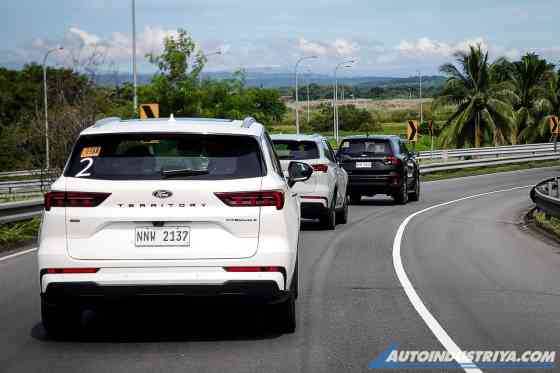
Yes, the ride is slightly firmer so as not to give the crossover a wallowy suspension, but the Territory Hybrid was still able to soften harsh bumps and make short work of rough roads. The suspension also did an impressive job of not bottoming out when we had to contend with several undulations while going down Asin Road on our way back to Metro Manila. Combined with improved Noise, Vibration, and Harshness (NVH) deadening thanks to a new acoustic glass to keep outside disturbances to a minimum, the Territory is a nice vehicle to be in on long road trips or in the bustling city.
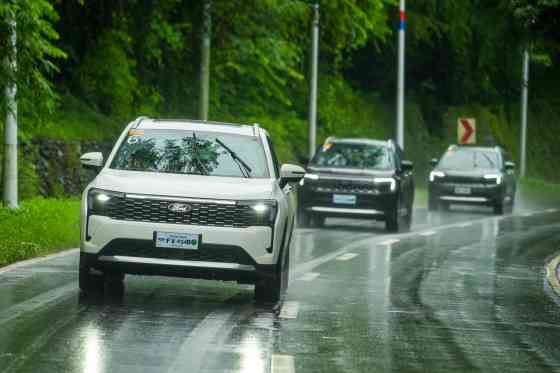
While crossovers are not exactly known for their handling characteristics, the Territory Hybrid was still able to deliver a fun experience. It’s no Ford Focus by any means, but through the many turns through Kennon and Asin Roads, the crossover was easy to navigate through the twisties and sharp corners.
Points for Improvement
Despite all its high-tech gizmos, impressive powertrain, and admirable handling, the Territory Hybrid still has plenty of improvements to work on. I’m not particularly fond of the rotary-style gear selector, as I sometimes can accidentally set it to Park instead of Reverse while parking. You have to intently look at how much you're rotating it. Its placement also means some drivers might mistake it for the volume knob, which is also located near the gear selector.
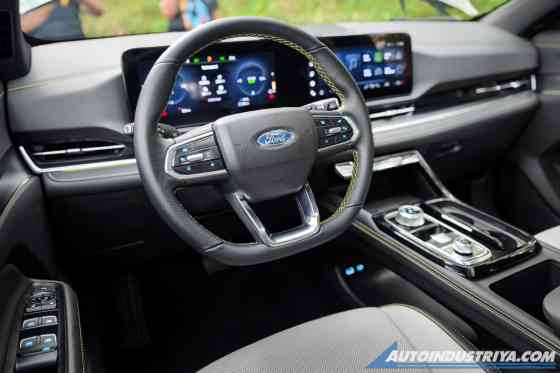
While the Territory has a great chassis that’s both comfortable and relatively agile, the lack of steering feedback slightly sours its handling capability. Don’t get me wrong, it will turn fairly sharply, and it’s agile without being wayward, but the fact that there’s little to no steering feedback despite having a “Sport” mode for its steering affects its handling capabilities.
The infotainment screen is great, and I love how Ford updated the main screen to display both Android Auto and Apple CarPlay while also showing the HVAC controls simultaneously. What I didn’t like about it was that when you adjust the fan speed or temperature, the main screen goes to the climate control menu. What’s the point of having the sub-menu at the bottom of the screen if the menu itself will be on full display while making slight changes? Hopefully, Ford changes this in a future software update.
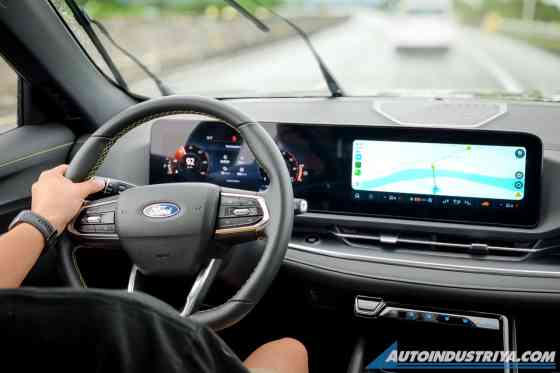
Last but not least is the forward collision warning that’s part of its suite of ADAS. Even at its closest setting, the FCW tends to sound off despite the vehicle in front of it still being several meters away. We’re not entirely sure if it has to do with the hardware or software, but we hope Ford gets to rectify that.
Is this worth it?
When Ford launched the all-new second-generation Ford Territory, plenty of buyers flocked to it thanks to its competitive price, turbocharged engine, and many features. But when the BYD Sealion 6 arrived in the country with a price tag of PHP 1.548M and put every compact crossover on notice with its plug-in hybrid capability, Ford had to answer quickly, and they came up with the Territory Hybrid.
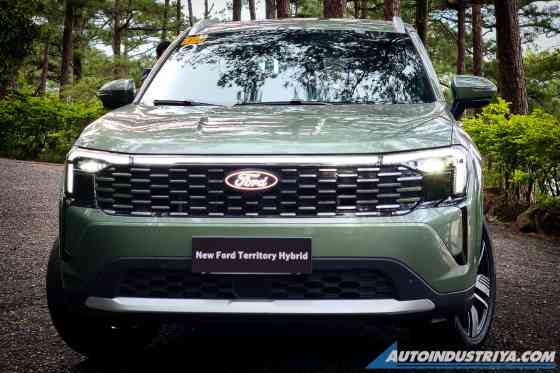
Yes, it’s not a PHEV like the Sealion 6, which can run on pure electric power for several kilometers without trouble. But there’s a caveat to having a plug-in hybrid powertrain: complexity. Self-charging hybrids like the Ford Territory are simpler while still giving drivers the ability to sip fuel and, at the same time, have plenty of power on tap should they need it.
It may not have the innovative approach to HEV like the Honda CR-V RS e:HEV, but the Ford Territory Hybrid Titanium X is selling at PHP 1 million less (PHP 1.599 million versus Honda's PHP 2.605M sticker price), comes with (almost) similar level of features, and delivers equal, if not better performance at a fraction of the suggested retail price.
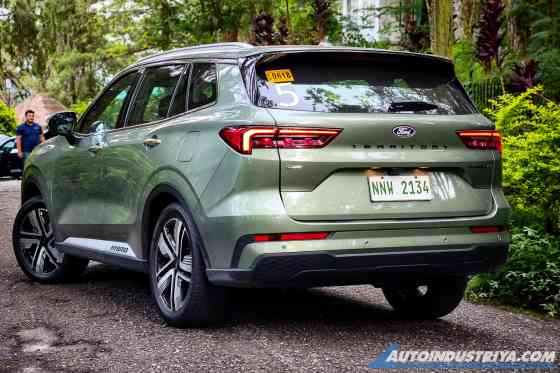
Our real issue is that the Ford Territory Hybrid isn't changing the rulebook, even though we liked it overall. We've been used to them trying something different and novel, and forward-thinking. Perhaps this approach will work, so there's nothing to do but wait and see how customers respond to the Territory Hybrid.