One Crash At A Time

What will it take to improve road safety in the Philippines?
Like many of you who drive, ride, or commute, I don’t know what to make of the crashes and incidents that happened in the last few weeks.
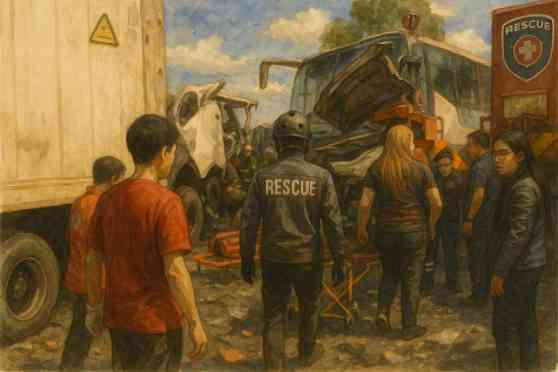
On 23 April, a heavy container truck was unable to make it up a hill in Marikina, lost drive and/or brakes, allowing gravity to take over, crushing a car and a jeepney behind it. Three died, including a mother and daughter in the car.
On 1 May, a bus with a driver who momentarily lost awareness crashed into vehicles waiting to pay toll at SCTEX. Whether he fell asleep from fatigue or the energy drink he took somehow affected him, only he knows. What we do know is that 10 people were lost, and we can only hope they didn’t feel a thing.
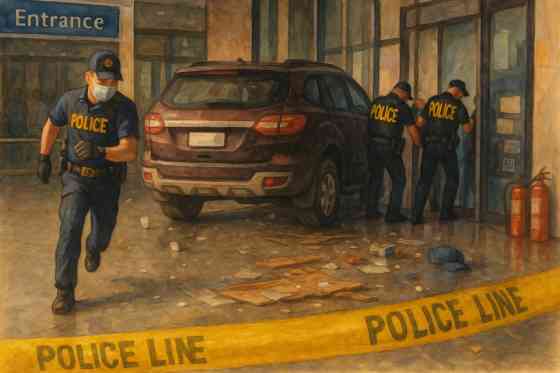
Coverage and investigation into that incident has barely begun, but then on May 4, we saw footage of a commotion at NAIA with an SUV slamming into a glass wall, and with people all over the sidewalk. The driver of the SUV unintentionally floored the gas, punched through the stainless steel bollards held only by four bolts, and rammed into the crowd of passengers and their loved ones. The gut-wrenching wails from a man were all we could hear. He was the husband of a woman hurt, and his little girl was killed.
The incidents make me sick to my stomach and are genuinely concerning. Imagine you’re just dropping off family at the airport, and then the next thing you know, you’re on the pavement. Imagine you’re just waiting to get through the toll booth, and then a bus slams into your back.
These are just three of the many high-profile road crashes that resulted in people being killed and families torn apart. Yes, there are more. And thanks to the advent of CCTV, dashcams, and ultra-clear cameras on smartphones, all of us have a front row seat to the carnage. We’ve almost forgotten about the Superman incident in Marilaque, the recent road rage shooting, and the motovlogger. We won’t bother repeating her name here.
There’s a lot of chatter in the many automotive and motoring group chats and beyond, and it’s all about theories on these incidents. From slippers to drowsiness from maintenance medication, to unfamiliarity with automatics, to broken brakes, all kinds of theories have been floated around. These are just conjectures because only the person behind the wheel would know for sure exactly what happened and what mistakes were made.
Perhaps what is more important -or shall I say what’s more concerning- is the talk about how to prevent these avoidable incidents. There are individuals -particularly influential individuals- that are calling for technology to prevent incidents, as well as for new legislation to address these matters directly.
The technology already exists to prevent accidents like the SCTEX crash and NAIA crash, and it’s called ADAS or advanced driver assistance systems. I’m referring to autonomous emergency braking (AEB) and pedal misapplication programs. But these technologies are usually found in much newer range-topping models, and are not generally standard for entry or even mid-grade variants, nor can these be retrofitted into older vehicles, even if it were somehow economically viable. Such systems are expensive.
There is also the case of NCAP, or no-contact apprehension programs, that the SC pressed the stop button on. Yes, CCTV technology can be used, and yes, it can serve as an alternative means of enforcement and deterrent, but there is a lot of potential for misuse or even abuse. My main concern: Is the person observing the camera credible (e.g. an experienced driver, seasoned enforcer, or HPG) or just some new hire by the LGU’s private contractor and told to hit a quota? Let’s not even get into the varying fees based on different LGU ordinances.

But the call for new legislation is my biggest concern. It seems every time there is an issue, here come Senate hearings, all kinds of new bills from the upper and lower houses, and eventually laws. Granted, it’s the legislative branch’s function to function as oversight over certain executive functions (and dysfunctions) and to craft new laws to address problems, and those are perfectly fine. My issue with it, however, is that the laws being crafted are too specific. What we probably need is a full overhaul and update of Republic Act 4136.
The Land Transportation and Traffic Code is the mother law concerning road transport in the Philippines, and it’s already a very dated law. While it has been amended by all kinds of EOs and RAs, it still needs significant updating to craft a modern highway and traffic code. Why? Because it was passed in 1964 and created the Land Transportation Office…’s predecessor: the Land Transportation Commission.
Student permits back then cost PHP 3, while licenses cost PHP 5. It has terms we no longer use, like barrio, and even has provisions for animal-drawn vehicles. It cannot account for newer, faster cars with more technology and electronics, nor can it account for modern traffic congestion, emissions, internet-connected vehicles, and the like. It even comes from a time when the maximum speed limit was 80 km/h. Even the most basic cars now can easily do well beyond that on the expressways.
Even if no new mother law is crafted, then -in my opinion- we go back to the real status of driving here: anarchy.
Yes, it is absolute anarchy out there with traffic, accidents, the hot weather, the rainy weather, the road rage, the wanton disregard for authority, a lack of responsibility, and the ignorance of even the most basic of road rules. This problem is a combination of education, discipline, and enforcement. There are probably more, but the issue really centers around those things.
Enforcement of rules that actually make roads safer and traffic flow smoother is severely lacking. Most departments are just content to enforce things like number coding or truck bans, even though these are not road safety violations. Maybe they can package in a number coding or truck ban apprehension by actually looking at the condition of the vehicle; something as basic as checking if signal lights, headlights, and brake lights are working, or even inspecting the state of the tires, would do a lot of good on the spot. Not difficult, right?
LTO, MMDA, or LGU traffic enforcers should be firmly implementing rules against blocking intersections and lanes, hogging/driving slow on the left lane, ignoring pedestrian crossings and the like. PUVs are getting away scot free because even basic rules under RA 4136 are not enforced upon them, like no riding on the running boards (AKA: sabit) as well as dangerous driving and swerving. Even ASBU enforcers turn a blind eye to them during spot emission checks. Have you ever seen a jeepney pulled over for smoke belching?
When enforcement is lacking and/or seasonal, then the result is a lack of discipline. There is no respect for authority and rules-based order because enforcement isn’t consistent or painful. I come from a generation that was told to stand in the corner or squat if I messed up. For worse offenses, I got the belt. It teaches you a respect for authority, and to not do it again. But on the road, there’s no respect for authority unless maybe it’s the PNP-HPG apprehending you. Or Bong Nebrija. And it can work. Just look at Subic. Drivers actually respect the enforcers there because they don’t mess around.
There is clearly a lack of driver education, rider education, even cyclist and pedestrian education. This should be taught by parents to their kids, by kuyas and ates, by teachers in schools, and by universities, by authorities, heck maybe even by the churches regardless of denomination.
If you’re going to drive, bike, ride, or walk on or along the road, observe the dangerous acts others do and do not imitate. Take it upon yourself to improve your acuity for driving and discipline on the road. Road safety is a shared responsibility.
The good thing is that the President can no longer turn a blind eye to the problem and dismiss these incidents as mere isolated cases. These are symptoms of a systemic problem at the heart of transport, and it has to change. Soon, we’ll hear and read of things like major amendments to licensing, probably a new law on road rage, as well as an uptick in all the cute OPLAN names you can think of. We will probably hear of drives to stamp out corruption at the LTO, new medical check requirements, and other fancy new things. But enforcement, education, and discipline are truly the key factors.
As someone who travels fairly frequently by air, I have a strange fascination for the old show Mayday or Air Crash Investigation, most of which are on YouTube now. It’s my white noise when I work or when I’m doing something else, like cooking or even when I’m just chilling on the couch.
No, it is not a fascination with the macabre, but rather a fascination for the investigative process. Things like the search for clues amidst the wreckage, the interviews with witnesses or survivors, to the painstaking process of recreating the events or even reconstructing the plane. It’s CSI, but real life. The goal: to show how aviation became so safe through technological innovation, engineering, meteorological studies, behavioral studies, CRM, and the like. The only problem: safety improves one crash at a time.
Road transport in the Philippines is now going through the same painful and tragic process. We didn’t have to, but it’s evident now how bad the situation has become. And any changes made now are merely downpayments, we will only feel the effect years or decades down the line.
Like you, I just hope it won’t cost too many lives to get us out of the madness.