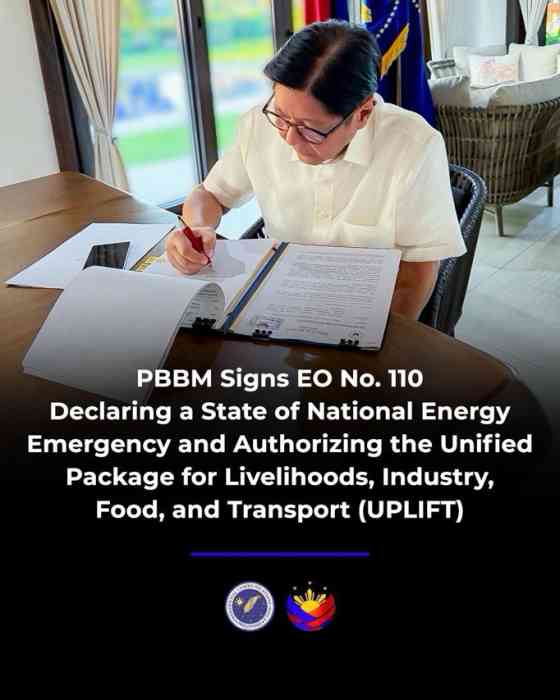
Executive Order No. 110: Ayuda, accelerated EV adoption, and more

The Philippines is under a State of National Energy Emergency
So the government has effectively acknowledged that an oil crisis is underway, driven by the ongoing US-led conflict in the Middle East. While several ASEAN neighbors moved earlier and have (for now) managed to keep their fuel prices relatively stable, the Philippines is only stepping in at this point through Executive Order No. 110, which places the country under a State of National Energy Emergency.
“The reason that I declared an Energy Emergency is to provide [the] government with more options should the need arise. Binibigyan nito ang ating pamahalaan ang mga kapangyarihan kumilos ng mas mabilis, bumili ng langis na hindi na kailangan na dumaan pa sa matagal na proseso, at pagsamahin ang lahat ng ahensya sa isang direksyon,” said President, Ferdinand "Bongbong" Marcos, Jr.
Ayuda
A closer reading of EO 110 shows that while there is no mention of lowering or suspending the fuel excise tax, the order outlines a range of targeted interventions to be carried out by various government agencies, which focus more on stabilizing supply, supporting key sectors, and managing the broader impact of rising fuel costs rather than directly cutting pump prices.
For instance, the Department of Energy (DOE) is tasked with ensuring that the country maintains adequate fuel reserves, while also working to cushion the impact of ongoing volatility in global energy supply. The EO also authorizes the DOE to procure oil through an expedited process.
As for the transport sector, the Department of Transportation (DOTr) is tasked with rolling out fuel subsidies for PUV drivers and/or operators, fare subsidies for commuters, and the continuation of the Libreng Sakay program. Yes, fuel subsidies, a.k.a. ayuda.
It may also extend LRT and MRT operating hours, and implement temporary reductions, suspensions, or deferrals of toll fees. These measures are largely targeted at public transport and the commuting public, rather than at all motorists.
The EO also directs the DOTr to work with local government units (LGUs) to establish priority transport lanes to improve traffic flow and, in turn, reduce fuel consumption and dependence on petroleum products. In the Philippine context, this could refer to dedicated bus lanes, bicycle lanes, or other corridors that prioritize higher-efficiency modes of transport.
Speedy adoption of EVs
One of the key provisions of EO 110 is the government’s push to accelerate the transition to electric vehicles (EVs), particularly in mass transport. It also directs the Department of Trade and Industry (DTI) to ramp up efforts promoting the adoption of EVs, renewable energy, and other energy-efficient solutions across the transportation, logistics, and manufacturing sectors, aimed at reducing the country’s reliance on petroleum products.
The government has also called on the private sector to adopt fuel and energy-saving measures, including flexible work arrangements for employees when feasible, a.k.a. work from home, energy-efficient practices in business operations, and other initiatives aimed at reducing overall energy consumption.
This energy emergency declaration is in effect for one year from issuance, unless extended or lifted by the President.