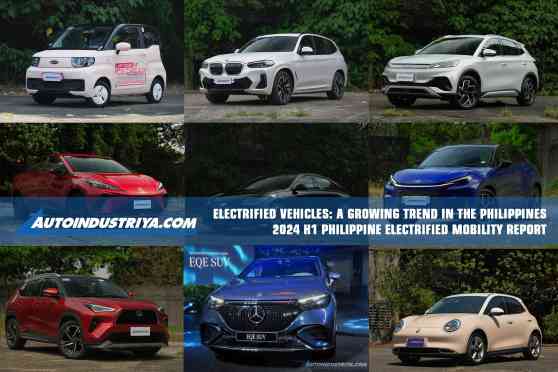
Electrified Vehicles: A growing mobility trend in the Philippines

2024 H1 Philippine Electrified Mobility Report
The Philippines is on the verge of a revolution in mobility: electrified vehicles. Albeit in its early stages, the adoption of electrified vehicles is steadily gaining momentum. Government incentives, technological advancements, and environmental concerns drive this electric revolution.
Government initiatives
The Philippine government passed Republic Act 11697 or the Electric Vehicle Industry Development Act (EVIDA) in April 2022 to popularize the development of an EV industry as well as promote the use of zero and ultra-low emission vehicles through tax incentives and other non-fiscal benefits for better sustainable transport solutions. Non-fiscal incentives include exemption from number-coding traffic reduction programs, preferential parking, and complimentary charging benefits. The Department of Energy (DOE) has so far been tasked as the agency to certify which vehicles qualify for these benefits.
It also aims to promote the installation and maintenance of charging stations for these electrified vehicles around the country. A public awareness campaign to educate the public about the benefits of EVs and dispel misconceptions, but it needs more momentum.
The Philippines started to spur this growth with Executive Order 12 signed by President Marcos in January 2023 to officially bring down the import tariff for battery electric vehicles to zero. This was followed with Executive Order 62 just recently, which brings down the import tariff for hybrid electric vehicles to zero as well.
Technological Advancements
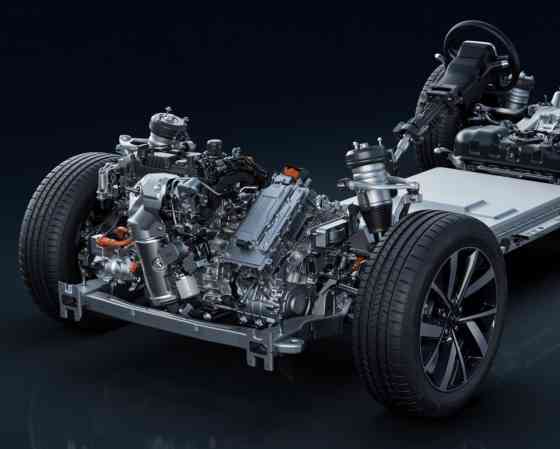
The rapid development of electrified vehicle technology has also played a key role in increased adoption. Advancements in battery technology, range, charging infrastructure, and vehicle design have made EVs more efficient, reliable, and accessible.
As for hybrids, range-extended EVs have also made their way to the country offering the best of both worlds. One such example is the BYD Sealion 6 DM-i. Basically it has an electric motor driving the front wheels but also has an internal combustion engine that acts as a generator to charge the batteries, much like the Nissan Kicks e-Power. But where the Sealion 6 DM-i shines is that you have the option to charge the batteries via an AC charger. That effectively gives you a greater all-electric driving range, and remove the range anxiety that's associated with full EVs.
Environmental Benefits
Electrified vehicles offer several environmental advantages over legacy gasoline or diesel-fed internal combustion engine (ICE) cars. By reducing emissions of harmful pollutants and greenhouse gases, EVs contribute to cleaner air and a healthier environment. This is particularly important for the Philippines, which faces challenges related to air pollution and climate change.
The same applies to hybrid vehicles, especially those that have an EV mode or cruise under full electric power. Based on the numerous hybrids that we've tested, HEVs, PHEVs and range-extended EVs offer excellent city fuel efficiency as their ICE engines barely take over the propulsion during gridlocks and slow city speeds. Since the ICEs don't fire up that much, less greenhouse gases are emitted during operation.
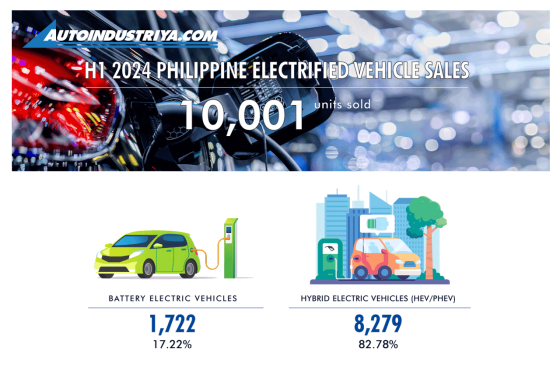
The numbers don't lie
For the first half of 2024, the Philippines has seen significant growth in electrified vehicles. Newly registered electrified vehicles totaled 10,001 units for the first half of the year compared to 10,388 units for the calendar year of 2023. As not all vehicle distributors/importers were willing to share their sales figures, we refer to the Land Transportation Office (LTO) for registration data.
Of the 10,001 units for 2024, 1,722 units are battery electric vehicles (BEVs), while 8,279 units are hybrids (HEVs), which include PHEVs. In contrast, 2023’s figures comprise 749 BEVs and 9,639 HEVs. It is worth noting that the majority of the BEVs registered are in NCR.
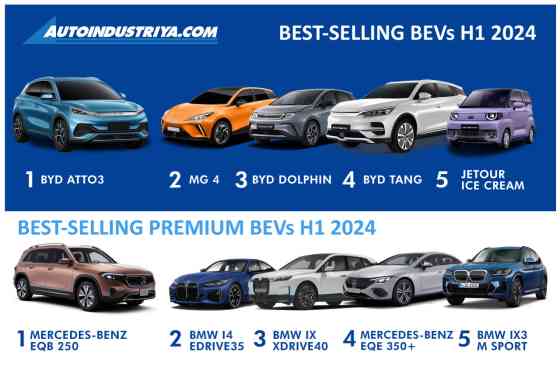
Best-selling BEVs for H1 2024
Leading the charge in EV adoption are Chinese-made models from BYD, MG, and Jetour. In the premium segment, BMW, Mercedes-Benz, and Lexus lead the sales figures.
For the first half of 2024, the best-selling battery electric vehicles (BEVs) are the BYD Atto 3, MG 4, BYD Dolphin, BYD Tang, and Jetour Ice Cream for mass-market offerings.
The Mercedes-Benz EQB 250 took the crown in the premium segment followed by the BMW i4 eDrive35, BMW iX xDrive40, Mercedes-Benz EQE 350+, and BMW iX3 M Sport.
“I believe Filipino consumers will continue to explore and look into BEVs and can expect growth of this segment further as seen in the numbers CY 2023 vs H1 2024,” commented Mr. Bob Palanca, Managing Director of BYD Cars Philippines.
"We believe that the premium EV segment will continue to evolve, driven by technological advancements and shifting consumer preferences," commented Mr. Adrian Spencer Yu, president of SMC Asia Car Distributors Corporation (BMW PH).
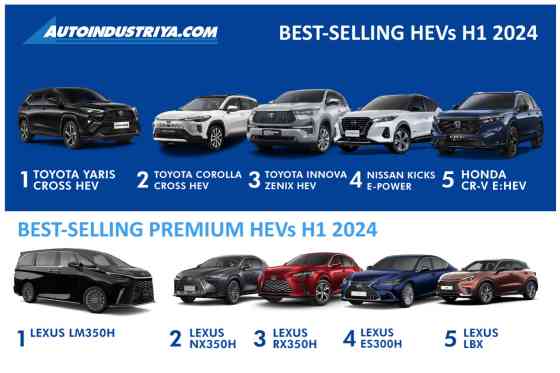
Best-selling HEVs for H1 2024
In the hybrid sector, legacy brands continue to dominate the market. Toyota, Nissan, and Honda lead the mass-market brands; while Lexus leads the premium segment followed by Land Rover in a very far second. Other premium brands may begin to introduce hybrid models with EO 62 lowering tariffs to 0.
For the first half of 2024, the best-selling hybrid electric vehicles (HEVs) are the Toyota Yaris Cross, Toyota Corolla Cross, Toyota Innova Zenix, Nissan Kicks, and Honda CR-V for mass-market offerings.
The Lexus LM leads the premium segment followed by the Lexus NX350h, Lexus RX 350h, Lexus ES 300h, and Lexus LBX.
-
“BEVs will continue to be a strong choice given that infrastructure is slowly being built, better consumer understanding on BEVs that it is significantly cheaper to maintain; with longer ranges of newer EVs, you really do not need to charge outside your home. Home charging can help you save thousands of Pesos when compared to commercial charging,” Palanca added.
"While there will always be a demand for larger, more luxurious models, we anticipate a growing trend towards smaller, more efficient EVs. These vehicles offer a combination of performance, sustainability, and practicality that resonates with a wide range of drivers, particularly in urban environments. As such, we are committed to expanding our portfolio to include a diverse range of EV options, catering to both the desire for spacious luxury and the need for compact, efficient mobility," Yu further added.
The challenges going forward
As with anything new, the adoption of new energy vehicles still faces challenges that comprise of:
- Limited Charging Infrastructure: While the government and private sector initiatives are working to expand charging stations, the current network may still be insufficient to meet the growing demand for EVs.
- Standardized Charging Ports for PHEVs and EVs: To date, there has not been a clear definition as to which would be the standard charging port to be used for PHEVs (Plug-in Hybrid Vehicles) and BEVs (Battery Electric Vehicles). When we consulted with the Land Transportation Office (LTO), they pointed to the Bureau of Product Standards (BPS) as the official agency to decide on such. Formal auto importers and distributors seemed to have agreed with using Combined Charging System Combo 2 (CCS2), a standard primarily used in Europe, but several gray market importers who source their vehicles from China meanwhile use the China domestic GB/T (guóbiāo/tuījiàn) standard. This may prove to be a problem in the future for buyers/owners should the BPS mandate CCS2 as the Philippine national standard.
- Cost of Entry: EVs often have a higher upfront cost compared to internal combustion engine (ICE) cars, which may deter some potential buyers.
- Range Anxiety: Concerns remain about the limited driving range of some EV models, especially for long journeys.
The Philippines is increasingly embracing electric vehicles (EVs), spurred by government backing, environmental awareness, and technological advancement. Despite ongoing challenges, the nation's dedication to sustainable transport and the advantages of EVs suggest a bright future. As the EV sector develops, the Philippines is poised to become a key player in shaping the ASEAN region's sustainable mobility landscape.