2024 Honda CR-V RS e:HEV

- Make: Honda
- Model: CR-V RS e:HEV
- Engine: 2.0L DOHC 16-valve Inline-4 Gasoline with Dual Motor Hybrid
- Max Power: 148 PS (Engine) / 184 PS (Motor)
- Max Torque: 183 Nm (Engine) / 335 Nm (Motor)
- Transmission: E-CVT, Front Wheel Drive
- Price as Tested: ₱2,590,000
9/10
8/10
9/10
8/10
6/10
8/10
Hybrid (but) High
Earlier today, Brent walked up to me at the office and pointed out something.
“You forgot to write the review of the CR-V hybrid,” said Brent.
He was right. I had completely forgotten about it. So much has happened in the last year that I couldn’t keep track of the many developments that have changed in our market. Electrified is becoming a big thing, many new brands have arrived, many new models have been launched, local manufacturing is getting a big boost with the return of a legend, and traffic has become insane, especially over the holidays.
Perhaps the CR-V just got lost amidst all that noise. Or perhaps maybe it didn’t make enough of an impact to be memorable? Let’s find out.
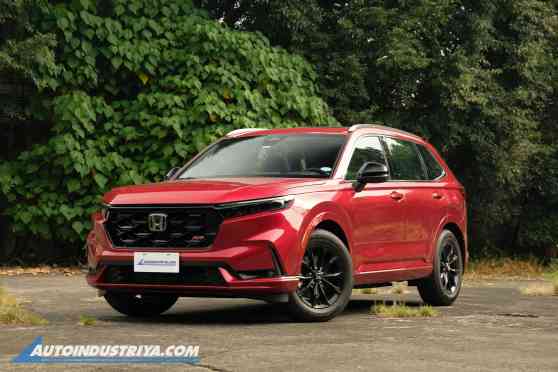
The new CR-V certainly has a long and distinguished lineage to live up to. The CR-V is one of the two OG crossover SUVs; the other being the Toyota RAV4. It’s had a long history here as a prime choice for a 5-seater crossover, a 7-seater crossover, and even a 10-seater AUV… yeah, they did that to drop the price of the second-gen CR-V. But we’ll cycle back to that later.
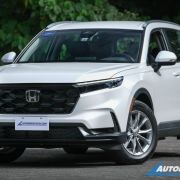
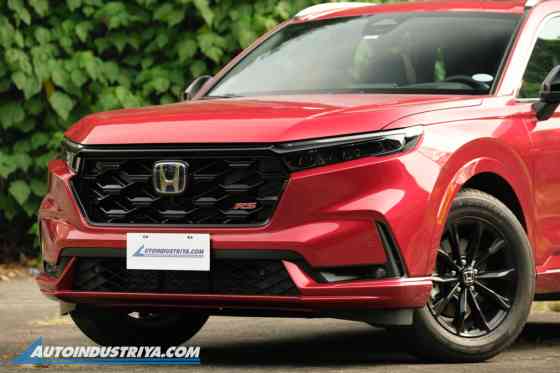
The styling is typical Honda: conservative. Yes, the headlights are sharp, and the grille is larger, but they didn’t really want to try to change too much from the previous generation. This is more of an evolution rather than a revolution, especially when you look at the rear end. From afar, it may be difficult to tell if you’re looking at a current or a previous generation.
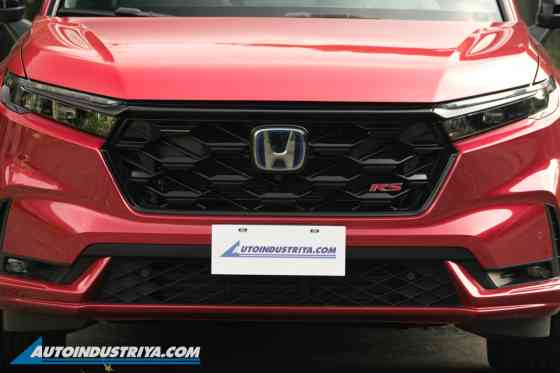
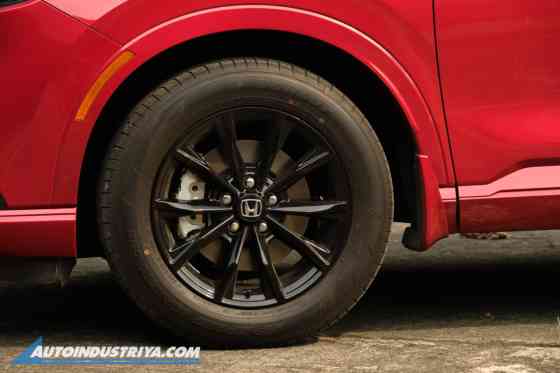
Honda did try to sporty it up with the RS package which is exclusive the the e:HEV variant. That’s why there’s not much chrome on the outside; this is straight-up red and black which is a color combo that does speak to me. But again, if we’re looking at it from the point of view of automotive design, we can’t really say that Honda is being innovative or avant-garde in any way.
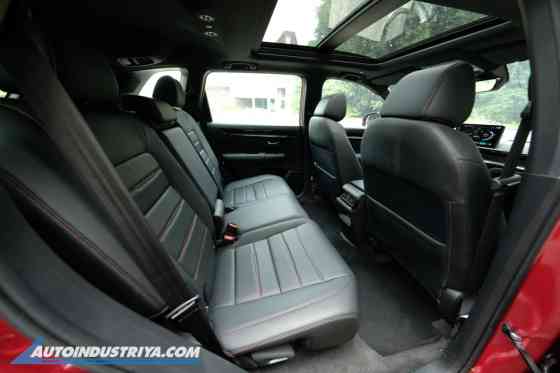
Where Honda does make it up is when it comes to space and how you access it. The rear doors, for instance, open so wide that it’s easy for kids and the elderly to get in and out. Actually, if you have to fit a child seat, the wide opening doors make it easy to secure it to the rear seat anchors.
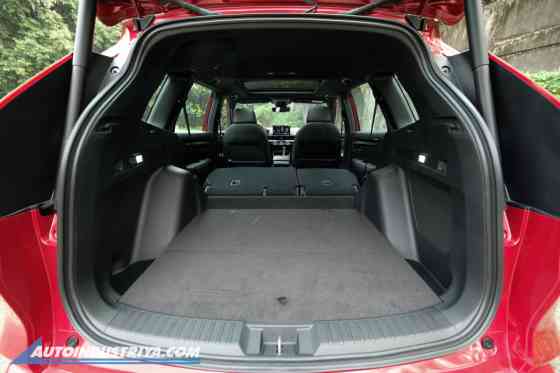
The cargo space is quite impressive too, as there’s plenty of length (39”), width (41”), and height (33”) even with all seats occupied. There’s no third row in the hybrid like the other variants because there is a hybrid battery underneath the boot floorboard. The only thing I can knock it for is the lack of a tonneau cover be it the retractable kind or the one that resembles a sunshade for your windshield.
Past generations of CR-V have been particularly innovative with the interior. A few examples we can think of include the second generation with its column shift, console-integrated handbrake, and picnic table, along with the previous generation that had buttons instead of a T-bar shifter. For this generation, Honda took zero risks.
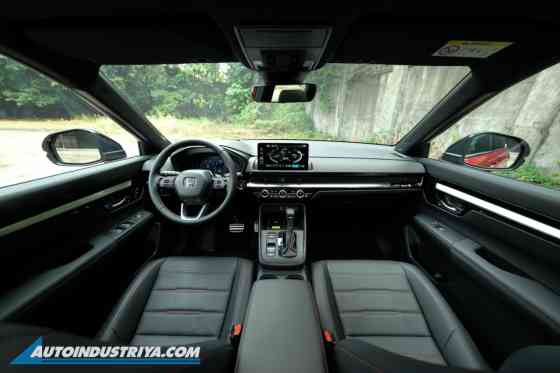
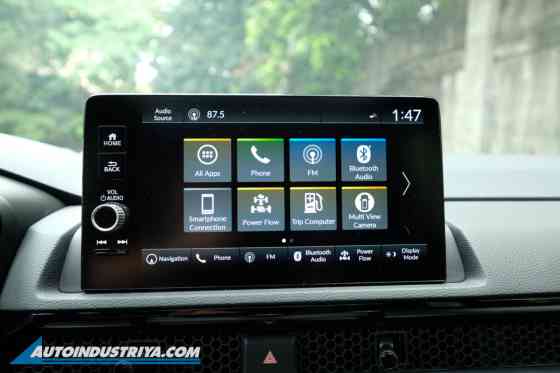
If you’re familiar with the other Hondas like the Civic and HR-V, this will feel exactly the same, albeit much more spacious. The cluster is fully digital, which looks neat. The infotainment is a touchscreen on top of the dash that we’ve become accustomed to with other brands like Mazda and Toyota. The automatic A/C controls have a triple dial and button arrangement. Perhaps the only risk they took is the honeycomb mesh accent (just like in the Civic) to conceal the A/C vents. It looks neat, but expect it to be a pain to clean once dust gets in there.
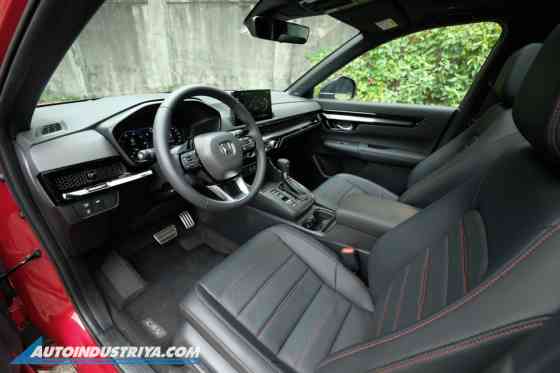
Where the CR-V shines is in the ergonomics. It feels good to sit inside, particularly in the driver’s seat. You get a lot of adjustments for the seat and excellent visibility all around. The drive selector and controls feel natural. It just feels good to sit here for prolonged periods of time in traffic or long drives.
For features, you get the usual: power amenities, climate control, adaptive cruise, advanced safety tech (because of Honda Sensing), multiple USB and USB-C ports, a wireless charger, and wireless Android Auto. What I don’t get as an Android user is wireless Android Auto; it does have the wired version, but that means the wireless charger is pretty much useless in my case. Oh well.
Another great aspect of the CR-V is the storage space. There are just pockets, compartments, and holders for everything. The wireless charger, while useless for an Android user, is just half of a fairly wide compartment. There are two cupholders in front, with a little receptacle for a wallet. The door pockets are spacious and the center armrest is huge; it can easily fit my EDC sling bag. Even if you’re in the back, the space is just abundant, and there is also a center armrest for your comfort.
Perhaps the part that is unique about the CR-V RS is the e:HEV system which brings together a 148 PS 2.0L direct-injection Atkinson-cycle (not 4-stroke Otto) gasoline engine, a more powerful 184 PS electric motor providing traction, and a lithium-ion battery (probably 1.06 kWh). What is unique about the e:HEV is the ability to make use of the three primary types of hybrid drive (series, parallel, power-split), particularly the way it makes use of hybrid drive.
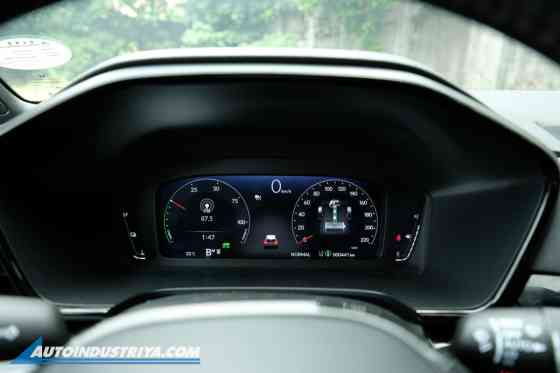
Honda’s hybrid system is different because it is a switching hybrid. At low speeds it will make use of the electric drive; this maximizes the instant and high torque of the electric motor. Driving it around the city, the CR-V is mostly in electric drive mode so long as I have the charge to do so. When the battery gets low, the car still stays in electric mode but the engine kicks in to run a second electric motor that serves as a generator to charge up the system. So yes, this is a two-motor hybrid.
When I took it out on the expressway, the CR-V was mostly in engine mode. The reason for this is the engine is much more efficient at highway speeds and cruising; easily able to maintain a lower RPM for reduced consumption, while providing ample power and still charging the system. That’s how Honda designed the e:HEV to work: to be efficient and fun by maximizing the abilities of both in the conditions they are best at. That’s why I was getting great numbers in the city, averaging 18.2 km/l even in heavy traffic, and around 19 km/l on the highway if I’m being mindful of the throttle pressure and speed.
What I like the most about the CR-V RS e:HEV is the way it feels when the road gets twisty, especially during my last drive up Baguio. Yes, the electric motor is efficient in low-speed driving, but the response and acceleration when you floor the throttle are there. It’s not EV quick, but definitely better if it was just on ICE. The sport mode on the drive mode selector unlocks a bit more responses, but what I enjoyed was the cornering ability. You don’t really buy a CR-V for handling, but it can.
The only thing that was a slight bummer was the paddle shifter system because it’s not a shifter anymore; it’s just adjusting the engine (or motor) braking to recharge the battery. The paddles are useful, but not as fun. What is neat is how you can play with the paddles when you’re going downhill, like I was on Marcos Highway from Baguio over the holidays. It helps minimize using the brakes and using the charging system to slow everything down for the corners.
As enjoyable, comfortable (ride is superb), and efficient as the CR-V e:HEV may be, the price is not. Over the years, Honda’s pricing has been going up, and up, and up. As such, the CR-V RS e:HEV is now at 2.6 million pesos. Even the non-hybrid variants are already starting at PHP 2.1 million.
The mindset at Honda seems to be about going premium. They feel they can command a higher price tag, and that also means they’re not going to be competing on volume. They want to compete on prestige; a stark contrast to the CR-V of decades past, when the average middle-class working employee or businessperson wouldn’t have thought twice about a CR-V.
Perhaps that’s why I forgot to write this review because even I’ll have a difficult time justifying it on my salary. Or I can just ask for a raise.