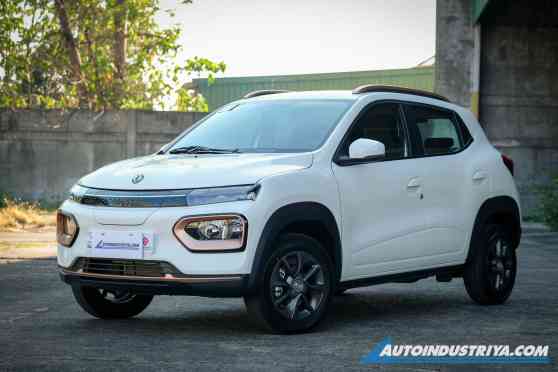
2024 Dongfeng Nanobox EV

- Make: Dongfeng
- Model: Nanobox
- Engine: Permanent Magnet Synchronous Motor; 28.9 kWh Li-ion
- Max Power: 45 PS
- Max Torque: 125 Nm
- Transmission: Single Speed, FWD
- Price as Tested: ₱888,000
8/10
7/10
7/10
7/10
8/10
7/10
The practical (electric) runabout
Let’s face it: A lot of people are still hesitant – scared, even – to the prospect of owning an EV.
Heck, even we in the motoring beat are still getting to grips with this fairly new concept. There are just a lot of new technologies to learn about, not to mention the jargon that goes along with it, and the charging to think of.
The same goes for driving an EV. I don’t know if it’s just me, but the general feeling is that most EVs tend to require a good read at the user manual first before setting off. Not that I’m saying you should skip that, but the feeling is just different compared to switching from one ICE car to another. The familiarity simply isn’t there – yet.
The Dongfeng Nanobox, however, wants to prove otherwise. After spending a week with it, the Nanobox wants to show that switching to an EV is not as complicated as it seems.
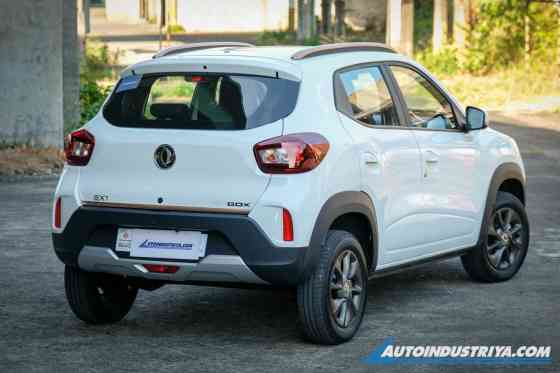
For starters, this small EV from Dongfeng goes by different aliases, depending on where it’s being sold. The Nanobox is basically a badge-engineered product of the Dongfeng and Renault-Nissan alliance joint venture. In its home market, the Nanobox is known as the Dongfeng Aeolus EX1 / Fengxing T1 / Fengguang E1 or Dongfeng-Nissan Venucia e30. But in the UK and European markets, the Nanobox goes by the name Renault City K-ZE, Renault Kwid E-Tech Electric, or the Dacia Spring Electric. Regardless of the name, they come from the same assembly line in Hubei, China.
Built on the Renault CMFA-EV platform, the Nanobox’s Alliance underpinnings were adapted for battery electric vehicle applications. The original Renault Kwid where the Nanobox was based, started as a crossover city car with a small 3-cylinder gasoline engine – very much like the Suzuki S-Presso.
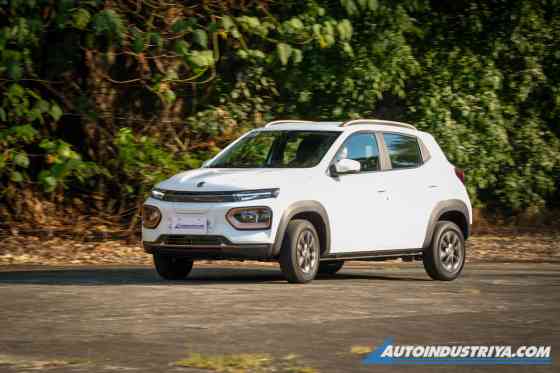
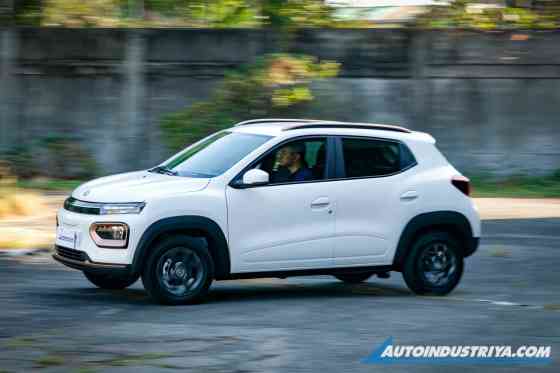
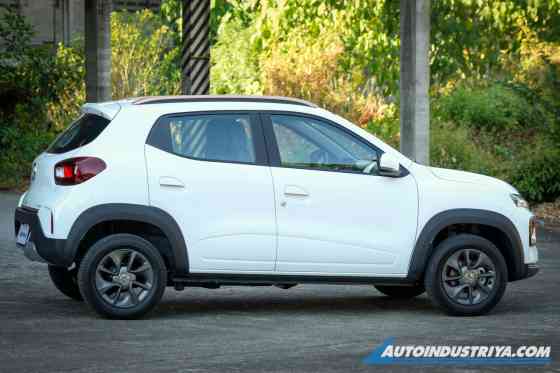
That’s the reason why the Nanobox also looks friendly on the outside. When you look at it, the proportions are what you’d normally see in an ICE car. Size-wise, the Nanobox is under 3.8 meters long, 1.6 meters wide, and 1.5 meters tall so it doesn’t fall far from the likes of the Wigo, the Brio, and the S-Presso I’ve mentioned earlier. Even the curb weight isn’t typical EV – only 921 kg.
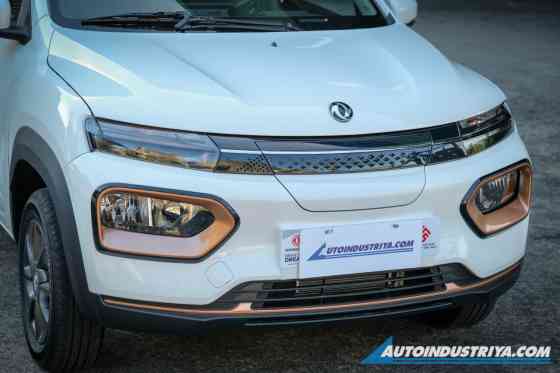
The only dead giveaway that the Nanobox is an EV is of course the grille that’s been shut, covering the charging port underneath. But elsewhere, it has split headlights in front with bronze accents, along with crossover-spec claddings. Furthermore, it rolls on 14-inch alloys wrapped in skinny tires, conventional door handles, functional roof rails, and even drum brakes at the rear.
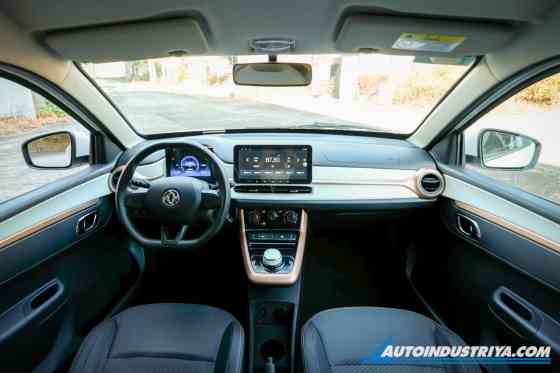
There are plenty of hard plastics around and some scratchy surfaces inside the Dongfeng Nanobox, but those are all forgivable because you know you’re getting a base car in the first place. The execution itself is not all boring either, as the cabin has a combination of white and bronze plastic trim pieces to go along with gray to give a hint of its fun character.
You get a 7-inch digital screen as your instrument cluster which has a pretty good resolution. It’s nice and informative showing things like the state of charge, power consumption, and whatnot, though there are still some Chinese characters that will need to be translated. Surprisingly, it even comes with tire pressure monitoring, though it does not display the exact readings.
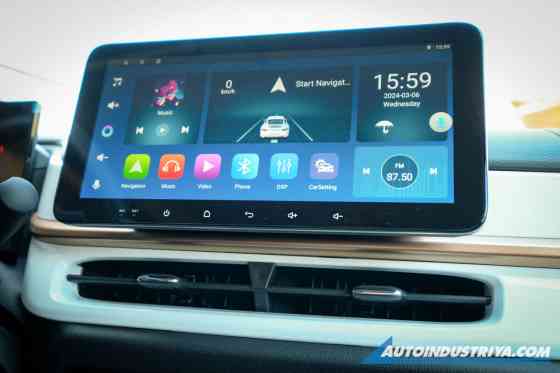
As for infotainment, the Nanobox has a 10-inch touchscreen that’s smartphone connection-capable, but through the Carbit app instead of Apple CarPlay or Android Auto. If you’re not a fan of using that, you can connect through Bluetooth to play your tunes through the EV’s two front speakers. Additionally, you won’t have the agony of putting up with endless submenus to change basic things like A/C fan speed, as it comes with physical knobs. You won’t have to fiddle with multiple drive modes either, as it does not have those.
Despite being an electric vehicle, you’ll still find some familiar things you’d normally see in ICE cars with the Nanobox. You still have a mechanical parking brake so handbrake turns are possible (responsibly and in a controlled environment, of course), and the car comes with a physical key. So yes, you’re gonna have to do the key twisting to turn the Nanobox on, much like a normal ICE car.
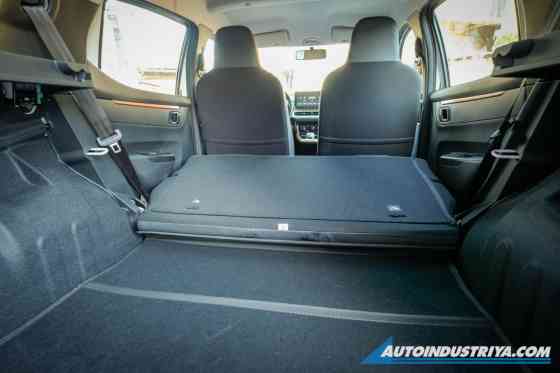
Space is okay for a guy my size (5’9”) on both rows, though I’d assume only four passengers could sit comfortably instead of five since the car’s not wide enough. In terms of cargo space, the Nanobox can fit things up to 17 inches long, 35 inches wide, and 31 inches tall with the rear seats up. But with the latter folded, cargo length can increase up to 45 inches.
However, I do wish what the Nanobox had was enclosed space for storage. Dongfeng may have stepped a little over the basic line, as the car doesn’t even have a glove box. For important documents, I guess you’ll have to settle for putting them in the front backseat pockets. What you’re left with are pockets on the doors, a cupholder in the middle, and a cubby hole near the gear selector where you can place your phone.
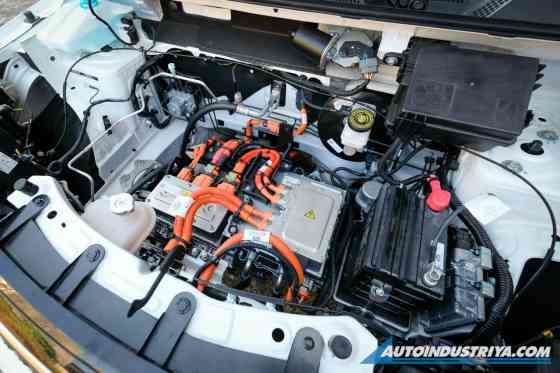
Under the hood of the Dongfeng Nanobox is a 45 PS, 125 Nm electric motor driving the front wheels. While 45 PS seems low even for a car this size, it’s the 125 Nm of torque that makes the Nanobox such a hoot to drive at low speeds. Imagine putting a Vios engine on a Wigo, and you’ll know what I mean – this EV is eager to go.
While its top speed is only 100 km/h, the Nanobox only needs a short stretch of road to reach it. Despite its domestic appearance, the Nanobox is zippy zippy. Since it's lightweight, it’s easy to weave in and out of traffic. It actually reminds me of the Suzuki S-Presso with the way it handles, but of course, the Nanobox is electric. It can be a bit bouncy though given the small footprint, but that’s all part of its character.
The energy being used by the electric motor comes from a 28.9 kWh lithium-ion battery, which gives the Nanobox an estimated driving range of up to 351 km based on the CLTC cycle. During my time with the Nanobox, I managed to do 7.4km per kWh at an average speed of 19 km/h, but that also involved long idling times while we were shooting the car. Honestly speaking, with the state of traffic in the Metro, you can expect to get somewhere around 250 km on a single charge.
With that range, it’s technically possible to do a back-and-forth trip in some of the nearby provinces outside Metro Manila on a single charge. Speaking of which, I was able to recharge the batteries from 50% to 95% using the 6.6 kW onboard AC charger in about 4 hours – that’s around 11% per hour when it’s plugged in at home.
If we do the math, that’s where the Nanobox proves to be superior economically in terms of daily running costs – which is really the upside of switching to an EV. With Meralco rates hovering around PHP 12 per kWh, you get to reach up to 250 km with the Nanobox by paying only around PHP 300, unlike normal ICE cars where you’ll shell out somewhere around PHP 1,500 – and that’s considering the gas-powered car does 10 km/l on average.
Overall, the Dongfeng Nanobox is not, and won’t be, a complete package. Of course, being a city car, it has its limitations. There are some features you’ll look for that the car doesn’t have. But perhaps, the more important question is, who is it for? In my opinion, the Dongfeng Nanobox is a great choice for a first EV for those who just started driving, urban commuters, and even senior drivers who don’t want a car that’s too complicated.
Because it’s simple and it’s easy to operate, the confusion is very much minimal. At PHP 888,000, it’s slightly above the price range of a starter car. But if you factor in running costs compared to a basic ICE car, then it’s not too hard to justify the additional cost of acquisition. You even get to use it 7 days a week since it's exempt from number coding.
In my opinion, it wouldn’t hurt if other manufacturers would try the solution Dongfeng is doing with the Nanobox if they want to make EVs become more mainstream. It lays the groundwork for familiarity as owners get to know the basics of owning an EV first, before taking in sophisticated things such as autonomous driving and whatnot.
After all, gas-powered cars were also once very simple before they became the tech-laden things they are today.