DPWH: more expressways, bridges, to decongest Metro Manila

DPWH lay out plans on decongesting NCR
The Department of Public Works and Highways (DPWH) has revealed their plans on how to decongest Metro Manila’s roads, which has been constantly ranked as one of the worst in the world in terms of traffic congestion.
According to Public Works secretary Manuel Bonoan the solution is to build more expressways and bridges.
Bypass road = expressway
According to Sec. Bonoan, the agency’s decongestion plan includes the expansion and upgrading of transportation infrastructure including the construction of new roads, bypass roads and more bridges.
The program focuses on the improvement and expansion of the national road network by building more by-passes, diversion roads, expressways, flyovers, interchanges, and underpasses.
Sec. Bonoan highlighted the completion of San Miguel Corporation’s Skyway Stage 3, which effectively reduced the travel time from Alabang, Muntinlupa, to Balintawak, Quezon City, from 2 hours to just 20 minutes.
The Tomas Claudio – Polytechnic University of the Philippines (PUP) Sta. Mesa Section is on-going and out of the target 28 ramps, 22 are completed, 3 are on-going and the other 3 ramps are still on the drawing board.
Another road project that Sec. Bonoan highlighted that will decongest and bypass EDSA is the 7.7-kilometer NLEX-SLEX Connector Road. This elevated expressway that is mostly traversing along the PNR rail track from Caloocan to Plaza Dilao in Manila will reduce travel time from SLEX to NLEX from two 2 hours to just 20 minutes. The project is already at 95% completion and now has three 3 interchanges located in C3 Road/5th Avenue in Caloocan, and España and Magsaysay Boulevard in Manila.
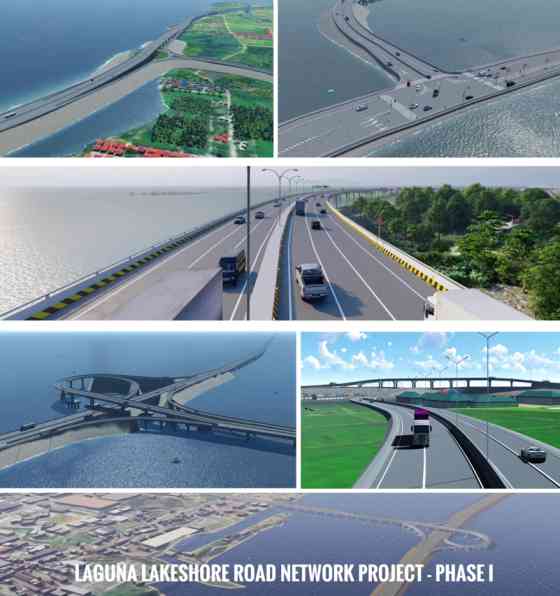
Other road projects that will bypass Metro Manila’s busy thoroughfares that Sec. Bonoan discussed are the C5 Southlink Expressway, Laguna Lakeshore Road Network Project (Phase I at 97% completion), and the Cavite-Laguna Expressway (CALAX) which is seen to reduce the travel time from SLEX (Binan) to Kawit from 2 hours to just 35 minutes.
More bridges
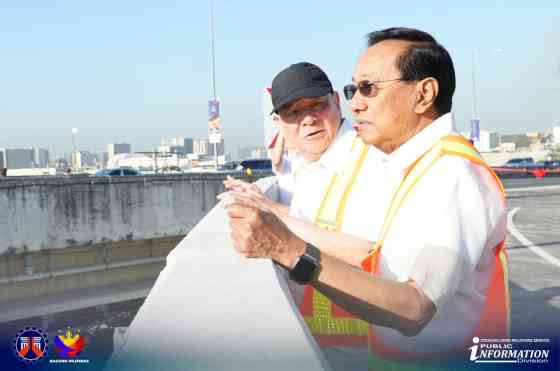
DPWH Secretary Manuel Bonoan (foreground) and San Miguel Corporation President Ramon S. Ang
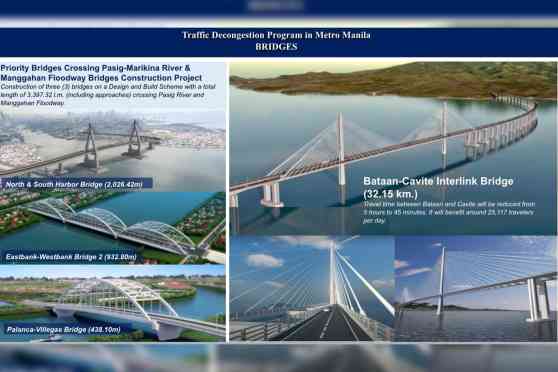
Decongesting Metro Manila is not all about building more expressways. Sec. Bonoan also highlighted the importance of prioritizing the construction of more bridges crossing the Pasig and Manggahan rivers.
3 bridges have already been completed, namely, the Binondo-Intramuros Bridge, BGC-Ortigas Center Link, and the Estrella-Pantaleon Bridge.
The design and build contracts for the other 3 bridges are on-going and civil works are expected to start within this year. Civil works for the North & South Harbor Bridge and Palanca-Villegas Bridge crossing Pasig River are targeted to start by the end of this year or early part of next year, while the construction of the Eastbank-Westbank Bridge 2 (crossing Manggahan Floodway) is set to commence in September of this year.
One of the landmark projects included in the Inter-Island Linkage Bridge Program is the 32-kilometer Bataan-Cavite Interlink Bridge (tollroad) across Manila Bay, which is set to be the country’s longest bridge once constructed. It is the biggest and the single most expensive project the DPWH is set to undertake which aims to reduce the travel time between Bataan and Cavite from 5 hours to just 45 minutes.
The detailed engineering design for this PHP 219-billion mega bridge project in Luzon is already at 97%, with the final approval of design plans currently ongoing.
Guadalupe and Lambingan bridge rehab plans by DPWH
The DPWH will also simultaneously work on improving the structural integrity and seismic resilience of existing bridges in Metro Manila. These bridges are the Guadalupe Bridge along EDSA and the Lambingan Bridge in Sta. Mesa, Manila.
According to DPWH, these 2 bridges will be under the JICA-funded Metro Manila Priority Bridges Seismic Improvement Project, and are set to commence this year. This rehab and seismic resilience works will ensure the safety of about 365,000 motorists who traverse EDSA through the Guadalupe Bridge and about 30,000 motorists who pass by Lambingan Bridge every day.
Additionally, Sec. Bonoan assured that the agency will continue to assist the Metropolitan Manila Development Authority (MMDA) in road clearing and removal of obstructions as well as promote active transport by building more bike lanes and pedestrian infrastructure in coordination with the Department of Transportation (DOTr).
He emphasized the collaborative efforts between government agencies, private sector stakeholders, and the community to implement the decongestion plan successfully.