EDSA Rehab: What you need to know

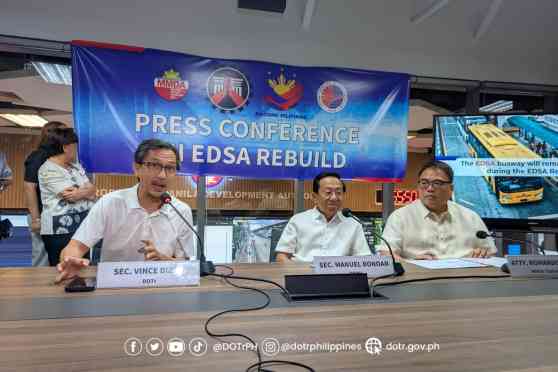
EDSA Rehabilitation details as explained by DPWH, DOTr and MMDA
[As the government continues to refine its rules for the upcoming EDSA Rehabilitation, this story will be updated. Please check back for the latest information.]
Commuters and motorists who traverse EDSA are bracing for significant disruptions as the Department of Public Works and Highways (DPWH) gears up to commence major rehabilitation works on the Metro’s busiest thoroughfare, which has been the country’s main artery since its construction began in 1939.
To mitigate the expected “carmageddon” during the rehabilitation works, the DPWH, in coordination with the Department of Transportation (DOTr) and the Metropolitan Manila Development Authority (MMDA), has unveiled a comprehensive traffic management plan.
DPWH
On the part of DPWH, it intends to deploy several contractors simultaneously to expedite the repairs. The approach will involve working from the inner lanes (bus lane) then outward to the bicycle lane (see video above), one lane at a time. This strategy is necessitated by the location of utility lines beneath the outer lanes. The DPWH is now coordinating with utility companies, urging them to lay their permanent lines before the new concrete is poured. Beyond road resurfacing, the project will also include the construction of pedestrian walkways and the fixing of existing drainage systems along EDSA.
According to Public Works Secretary Manuel Bonoan, preparatory activities are slated to begin on June 13th, with the actual construction kicking off a week later, around June 20th. The ambitious project aims for completion by 2027. Sec. Bonoan also said the EDSA southbound stretch from Guadalupe to Pasay will take first priority the rehab works.
DOTr
Recognizing the potential for severe traffic, the DOTr has secured a commitment for free toll on Skyway Stage 3, anticipated to begin sometime in July or August 2025. This toll-free access may even extend up to the Balintawak/NLEX exit, providing a crucial alternative route for many motorists.
Another free toll commitment secured by the DOTr will be from the Metro Pacific Tollways Corporation (MPTC) through its NLEX Connector. This elevated tollway stretches from Mel Lopez (R-10) Boulevard in Manila to Mindanao Avenue in Quezon City, with entry and exit points in NLEX (Smart Connect), España Boulevard, Magsaysay Ave., and 5th Avenue in Caloocan.
To further encourage the use of public transportation, the DOTr also plans to deploy an additional 100 buses along the EDSA Busway, while the MRT-3 will see the addition of more trains to increase its capacity.
MMDA
On the ground, the MMDA will implement a 24-hour Odd/Even scheme exclusively on EDSA to reduce the volume of private vehicles. Under this scheme, vehicles with license plates ending in odd numbers (1, 3, 5, 7, 9) will be prohibited on Mondays, Wednesdays, and Fridays. Those with even-numbered plates (0, 2, 4, 6, 8) will be prohibited on Tuesdays, Thursdays, and Saturdays. Sundays will be ‘free for all,’ says MMDA Chairman Atty. Don Artes.
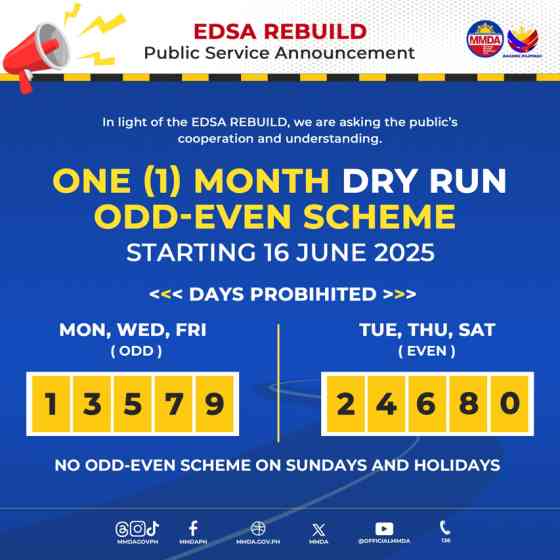
The 24-hour Odd/Even scheme will temporarily replace the existing Unified Vehicular Volume Reduction Program (UVVRP), or Number Coding, specifically along EDSA for the duration of the rehabilitation. According to the MMDA, Electric Vehicles (EVs), Plug-in Hybrids (PHEVs), and Hybrid Electric Vehicles (HEVs) recognized by the Department of Energy (DOE) under EVIDA are exempt from this Odd/Even rule, as are motorcycles, emergency vehicles, fire trucks, PNP patrol cars, Public Utility Vehicles (PUVs), Transport Network Vehicle Services (TNVS), marked government vehicles, and vehicles simply crossing EDSA intersections.
A total truck ban will be enforced on EDSA from 5:00 AM to 10:00 PM daily, encompassing not only cargo trucks but also tankers, garbage trucks, and provincial buses.
To manage two-wheeled traffic, the existing bike lanes will be repurposed into a shared Bike/MC Lane. However, motorcycles will be prohibited from using flyovers and underpasses along EDSA. The MMDA will also identify and announce alternative routes for motorists to navigate the expected congestion.
Before the full implementation of these revised traffic rules, the MMDA will conduct a one-month dry run to familiarize motorists with these new regulations, with emphasis on the Odd/Even scheme.
As Metro Manila braces for a potentially challenging period of road rehabilitation, the government hopes that this multi-faceted approach will, in the long run, lead to a significantly improved EDSA for all road users.