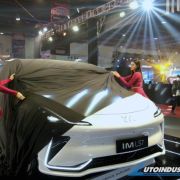
MIAS 2024: Why so much Chinese?

What no one dares to say about what we saw at MIAS
Two weeks ago, I was walking around the Impact Challenger hall for the Bangkok International Motor Show. As always, their show is nice: it’s quiet, well lit, spacious, and more importantly the A/C was working properly. It was a pleasure to work the floor, shoot videos and photos, and upload articles.
I ran into a colleague of mine -the editor of a very big Thai automotive website- and we did a bit of catching up. It’s always fun to swap stories with friends in the region; I tell him we’re envious of the manufacturing investment in Thailand which is why they get all the ASEAN vehicles ahead of us. I then asked him what he thought of their show which is easily the biggest in Asia over its two-week run.
His answer: Too much Chinese.
One look from where we were sitting and I see his point. While the banners of all major Japanese, American, Korean, and European automakers were hanging on the rafters as per usual, there were a lot more Chinese automobile banners there too. And at the Manila International Auto Show, the comments from many of you -our readers and viewers- are the same.
Why so much Chinese at the Manila International Auto Show?
It’s the inevitability that no automotive editor wants to discuss: the time of the Chinese auto brands has arrived and more are on the way. At MIAS, that’s exactly what we saw: the local importers and distributors put in a lot of effort for elaborate booths, displays, big discounts, test drives, and all kinds of entertainment, but many complained about why the majority of participating brands are from China.
MIAS is the perfect barometer to illustrate this trend. The numbers don’t exaggerate. In 2022 there were 12 brands present; 6 were from China. In 2023 there were 15 brands present; 9 were from China. In 2024 there were 23 major brands; 16 were from China. This year the ratio was 70:30 in favor of Chinese automobile marques versus everybody else.
Many sneered at how the M in MIAS became something else and were disappointed that many of the established brands that we already knew were not present. For one, it would be very improper for MIAS organizers to refuse a brand entry based on national origin. That kind of selectiveness will be bad for business.
The other reason is timing: the Philippine International Motor Show (PIMS) is also happening this year. That means in October (thereabouts) the World Trade Center Manila will again be the host of another motor show, but it’s with CAMPI members such as Toyota, Mitsubishi (also at MIAS), Isuzu, Ford, Suzuki (also at MIAS), and more. I seriously hope the A/C is working properly by then, but it won’t be as hot outside.
The presence of so many Chinese automobile manufacturers at MIAS is an indication of their eagerness to enter our market with a local partner (except for one subsidiary) and try to succeed. MIAS 2024 was not just a launch pad for cars from the already established brands here like GAC, MG, Chery, and the like, but also for entirely new brands like Lynk&Co. Heck, there were even brands that even I personally haven’t heard of yet up until then like Seres and Hycan.
More importantly, their cars are all getting much better as they invest more into R&D, long-term testing, and unique designs… well, mostly unique. They're offering more technology and features with price tags that are significantly less than other brands and long warranties. They can do this thanks to their huge economies of scale in manufacturing.
The problem, as you know, is not so much the car. The problem is geopolitical. The aggressive actions by the vessels of our much larger neighbor in our territorial waters are plain to see: water cannons, laser lights, blocking and outright ramming against our much smaller vessels. We turn on the TV and we see it. We turn to Facebook, Twitter, and YouTube we see it. If you’re still the type that opens a newspaper, then you’ll read about it.
Surely the Chinese auto companies that are banking on succeeding in the Philippines must be aware of the tension. Recently, I started asking them the questions that are on our minds: If any, what is your company’s position on the situation between our nations?
I directed this question to several senior Chinese automobile executives from different companies who flew into the country to attend MIAS. The gist of the answers from various executives from various brands are as follows:
1. Our people have no conflict against each other.
2. Economic ties are essential. It will bring prosperity to both peoples.
3. It’s all exaggerated because of America.
The first two are proper statements: if we are just talking about people like you and I, an ordinary Chinese person has no beef with an ordinary Filipino. And yes, economic ties are (or can be) mutually beneficial; we sell them our mangoes and nickel, and we buy all kinds of end products from them. But the third I didn’t expect.
Maybe there is some kind of adjacence, but I struggle to see the direct connection between superpower politics and how that correlates to the aggressive rhetoric. I definitely do not see the correlation to the behavior against our local fishermen within our EEZ and against our sailors bravely going into harm’s way to resupply our troops holding out on a rusted WW2 ship beached on a little atoll.
Now before the comments get out of hand, it’s important to note that these executives we spoke to are good people, but they may not be seeing the same images we Filipinos are seeing everyday. When I visited Shenzhen and Guangzhou a few months ago, I kept the TV in my hotel on the English version of CCTV News the whole time. Not once did I see any coverage of what’s going on.
That is the real problem: they might not be aware of how the political situation is making their efforts at marketing cars far more difficult in the country that is the recipient of the belligerence. That’s why there was so much disappointment (frustration, even) amongst visitors who went to MIAS 2024 and even the EV Summit 2023.
That’s why social media pounces on every Chinese automobile aftersales issue be it big, small, trivial, one-sided or even false. That’s also why many people are hesitant to buy Chinese cars save for the few brands that have already established themselves as front runners among Chinese auto brands. But even then, any small issue gets blown out of proportion because of public frustration.
We generally don’t delve into geopolitics in our work; we are all about cars, not politics. But it cannot be denied that it is a factor in the automobile market. We can also see it in our videos: save for a few models, reviews of Chinese automobiles net lower viewership and readership. Even our MIAS 2024 coverage (with a vast majority of Chinese brands) had less than half of the views versus our MIAS 2023 coverage on YouTube. That should be an indicator already, and that is something we’re seeing with other channels and websites.
The executives of Chinese car companies aiming to succeed in exporting to the Philippines should not turn a blind eye and dismiss this as some kind of false propaganda. It's a matter of understanding the sentiments of the customer base. Some do state an obvious fact: China makes everything else… and that's sent from my iPhone or Huawei or Xiaomi. That is true: all those products are made in China, among many others. So the reasoning is if Filipinos buy Chinese products anyway, why not Chinese cars?
The difference is that when it comes to a lot of stuff, the customer has no other option. All the major phone brands, all the major computer brands, everything is made in China. But when it comes to cars, customers do have options. And even if the products from other countries have fewer features, lower specs, and higher prices, it's not surprising that many likely make the choice to go for a vehicle from any other country.
We can only hope that the situation between the Philippines and China improves. Until it does, the marketing of Chinese cars in the Philippines will be fraught with challenges because it is the only clear avenue left for a Filipino consumer to make his or her sentiments felt.
Perhaps that's something that should be communicated to the head offices. If enough get talking, maybe it'll get to those that make the big decisions. Conflict has always been counterproductive to business unless your family name is Stark.