2025 BMW i4 to Baguio and back: The planning and pleasure of BEV

We take the BMW i4 on a classic roadtrip
The Philippine market is experiencing a surge in electric vehicle (EV) availability. The general understanding and utilization of these vehicles by many appear to be largely concentrated in the city and the greater metro or urban areas, primarily as a means to have smooth, quiet, and zero-emission transport without the restriction of coding.
There is another reason, though: range.
Although many EVs available in the Philippines possess sufficient battery juice to travel well beyond the National Capital Region (NCR), the limited presence of charging stations in provincial areas makes owners hesitate before undertaking that long drive and makes BEV unappealing to interested customers.
While marketing efforts by car brands have featured EVs completing long-distance drives, these achievements have frequently relied on a carefully laid-out route on controlled de numero type of driving and with the support of a backup vehicle with a power supply. This reliance tells the current limitations of the EV charging infrastructure for widespread long-distance EV travel and often suggests that these campaigns don’t fully reflect the typical “real world” user experience.
So, to prove a point, we have undertaken the task of proving that EVs can also be long-distance travel companions, even with the family. Our drive of choice: the BMW i4.
Asin Road
BMW i4
The BMW i4 is the brand’s all-electric Gran Coupé, which aims to be a versatile vehicle that excels in both spirited driving and everyday practicality. Its interior provides unexpected spaciousness that can rival some SUVs, making it a comfortable option for family road trips, cleverly disguised in a sporty four-door coupé body style. The i4 also offers ample trunk space, a satisfying 286 PS, and a reassuring range of up to 483 kilometers, further enhancing its appeal as a capable daily driver and long-distance cruiser.
Hill Station, Baguio City
Baguio City
After seeking guidance from friends well-versed in the world of EVs, I concluded that the most sensible choice for my first long EV trip would be the quintessential long-drive destination for many Filipinos: Baguio.
The distance isn’t as daunting anymore as it used to be. This is thanks to the ease of travel via SCTEX and TPLEX, making Baguio City even more of a favorite for those seeking cooler climates. Here's the challenge: depending on where you start in or around Metro Manila, Baguio is about 250 to 270 kilometers away. A range of up to 483 kilometers will not be enough, so charging will be needed.
The good thing is that Baguio does have some relatively convenient charging infrastructure, with at least three charging stations available within Baguio City itself. There are also another three or more along the way. Besides it being somewhat more “EV friendly”, Baguio City also offers plenty of hotels for a comfortable stay, great food selection from its many restaurants, and of course, its cool weather.
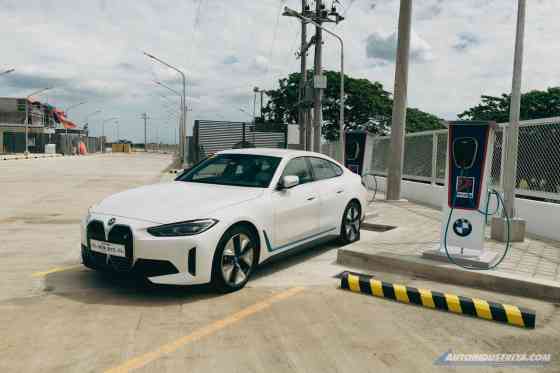
Free EV charging at BMW Destination Petron TPLEX southbound
Careful planning needed
Driving an EV necessitates a more meticulous approach to trip planning compared to traditional fossil fuel-powered vehicles. Ensuring a seamless journey from point A through multiple destinations and back again requires careful consideration of charging locations and distances. This is because the EV charging network in the Philippines is still in its early stages of development, unlike the extensive and easily accessible network of refueling stations for gas or diesel-powered vehicles.
As we commenced our journey from our home in Las Pinas, the BMW i4’s battery displayed a reassuring 82% charge, with the onboard system confidently estimating sufficient range to reach Baguio City with power to spare. But we’re in the Philippines, and driving conditions are far from ideal. This means that under these less-than-perfect circumstances, as well as spirited expressway driving, battery energy could be consumed at a faster rate than the initial projections.
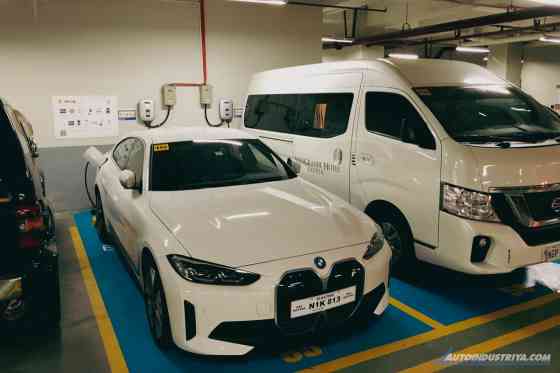
16A AC charging station at Sotogrande Baguio. Paid PHP 1,355 for 5 hours of charging (28% to 100%).
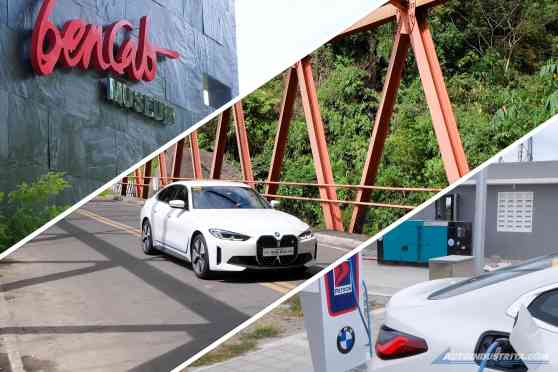
It's a good thing that BMW Philippines' parent company, San Miguel Corporation, has set up charging stations called ‘BMW Destination’ which are strategically located in select Petron stations. For this trip, I had to plan our lunch break at Petron TPLEX northbound (Victoria, Tarlac), where there are two BMW Destination charging slots. While we’re having lunch, the i4 was plugged in for some much-needed battery juice, and after 2 hours, we’re back on the road, and again with 82% battery charge.
Actually, I didn’t know that there were charging stations in Petron TPLEX, as the internet merely suggests there is one, but we are unable to easily verify if it’s already operational. My Plan B -if the BMW Destination at Petron TPLEX was non-existent- was to top up at Shell TPLEX Rosario.
Although Baguio City does offer EV charging stations, notably at Camp John Hay and SM City, these ports are frequently occupied, often requiring drivers to endure several hours of waiting time for their turn. Recognizing this potential inconvenience upon our arrival in the Summer Capital, my family and I opted to stay at Sotogrande Baguio. This strategic choice provided a significant advantage, as the hotel offers two dedicated 16A AC charging stations in their basement parking. This decision effectively allowed me to hit two birds with one stone: (1) readily available charging station exclusively for my use, while (2) also guaranteeing a secured and convenient parking space.
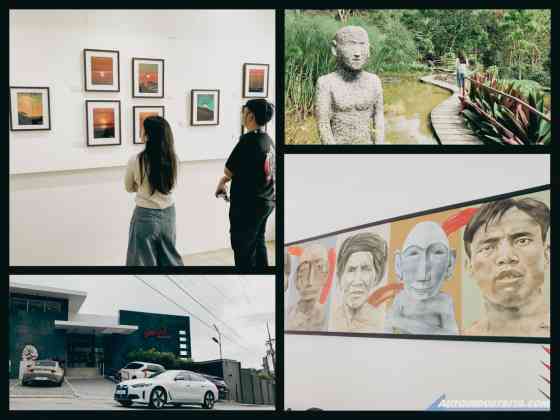
BenCab Museum
Side trip: BenCab Museum
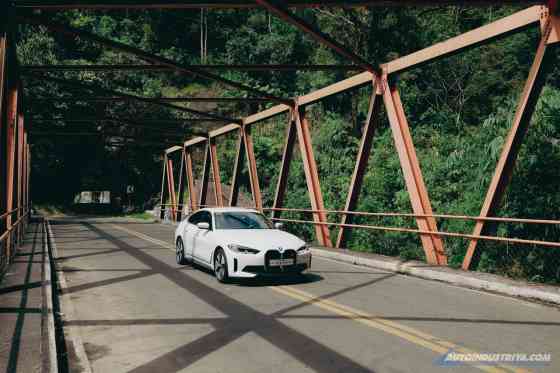
Knowing that the BMW i4 had more than enough range to reach Baguio City from TPLEX, we took a delightful detour along the famous but seldom-used Asin Road to visit the BenCab Museum. The smooth surface and sparse traffic on Asin Road provided a perfect opportunity to revel in the i4’s instant, neck-snapping torque and sharp handling through its curves.
Upon arriving at the museum, we were captivated by the extensive collection of Ben ‘BenCab’ Cabrera, the esteemed Philippine National Artist for Visual Arts, and the rich celebration of the diverse cultures of the Cordillera region showcased within its walls.
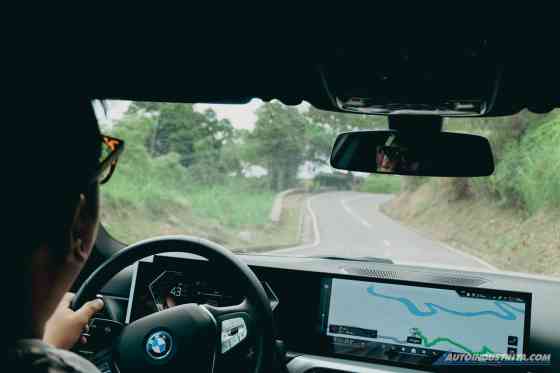
Asin Road twisties
EVs for long drives
To be honest, I’m still navigating the learning curve when it comes to these newer vehicles, especially EVs. Concepts like regenerative braking (regen), the distinctions between AC and DC charging, and the intricacies of one-pedal driving are all quite new to me. On top of that, this was my first time driving a Battery Electric Vehicle (BEV).
Our journey to Baguio City and back in the all-electric BMW i4 served as a demonstration of the evolving possibilities for EV long-distance travel in the Philippines. Despite the limitations of the current charging infrastructure, careful planning and leveraging available resources, like the BMW Destination chargers, our hotel’s facilities, and the i4’s regenerative braking, allowed for a comfortable and enjoyable trip for the whole family.
While the experience required more thinking than driving a traditional vehicle, it proved that traversing beyond Metro Manila in an EV and without a backup vehicle with a generator set is not only feasible but also offers a compelling driving experience, especially on scenic routes like Asin Road. As the charging network continues to expand, driven by both government initiatives and private sector investments, the range anxiety that currently lingers in the minds of many potential EV owners will undoubtedly diminish, paving the way for a more seamless and widespread adoption of electric mobility for Filipinos.