2026 Mitsubishi Destinator GT 1.5T CVT

- Make: Mitsubishi
- Model: Destinator GT
- Engine: 1.5L DOHC 16V Inline-4 Turbo Intercooler
- Max Power: 163 PS @ 5000 rpm
- Max Torque: 250 Nm @ 2500-4500 rpm
- Transmission: CVT, front wheel drive
- Price as Tested: ₱1,939,000
8/10
10/10
10/10
9/10
7/10
9/10
The Mitsu we've been waiting for?
I have always been -and will probably always be- a Mitsubishi fan.
All throughout my childhood, we’ve had Mitsubishi cars. From the boxtype Lancer, to a Minica and a Chariot (Space Wagon) in Japan, to even an Adventure for the business, and my personal Lancer CB that I restomodded, I can honestly say Mitsubishi has always been a part of the family.
The problem, however, is that many of the Mitsubishi models that we’ve come to know and love have also come and gone. Lancer, Space Wagon, Minica, Eclipse, Pajero, and Lancer Evolution are all gone. Okay, so they do have an Eclipse Cross, but we don’t get it here.
So that leaves us with aging models such as the 10-year old Montero Sport (after facelifts), the 14-year old Mirage G4 (after facelifts), and the 43-year old L300 (after updates and a new engine). The Xpander and Xpander Cross are also quite long in the tooth already, after being first launched in 2017. The Xforce is new, but the pricing is a tad too high, and it lacks force, while the Triton is doing just ok given the waning demand for newly re-taxed pick-ups and the fact that many aren’t too sold on the design.
That brings us to the Destinator, then. Long story short: it may have a few missed opportunities, but it is largely a vehicle that checks many of the hallmarks of Mitsubishi that we have been looking for.
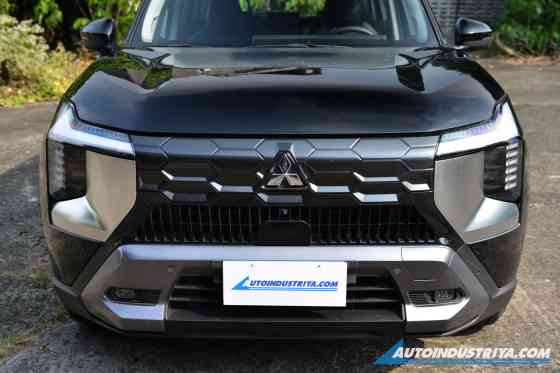
The name itself is unusual, following in the tire treads of Mitsubishi’s desire to break with past naming conventions as they did with Xforce and Xpander. The Destinator is, however, kind of a combination of the two: the design cues and platform of the Xforce, but the practicality and usability of the Xpander.
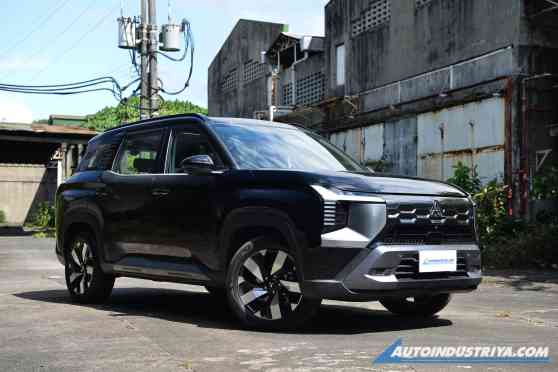
On the outside, yeah, there are definitive things borrowed from the Xforce, like in the way the front looks, but also from other models with the “Dynamic Shield”. Of course, the Destinator is longer because it’s a three-row and has to be able to competently sit 7 people, so it’s a little stretched out to 4.68 meters. The rear is also a bit more upright, with DESTINATOR neatly spelled out on the tailgate.
This being the top-of-the-line GT variant, it gets a panoramic glass roof. It’s nice, but not really necessary, and introduces a bit more complication and one more thing to maintain long-term. The rear also features a neat power open feature, as well as an extra camera (on top of the 360 camera system) on the upper rear glass, which is meant for the rear view mirror camera system similar to the Nissan Terra. Yes, it does share some features with Nissan.
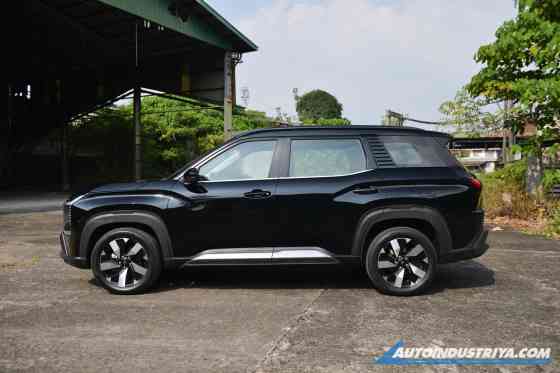
The vehicle is a crossover, so we won’t be seeing the body mounted to a frame underneath because they are one and the same. That’s why when you pop the door open, you’ll see the floor isn’t that high up off the ground like you would on a Montero Sport because there isn’t a thick frame that elevates it well above the 214mm stated ground clearance. So if there are people expecting it to feel like a Fortuner or a Monty or an Everest in terms of height, you may well be disappointed. However, if you’re coming from a Veloz, BR-V, or Xpander Cross, you will feel the upgrade in height.
The best part really is the versatility; by that I mean the many ways the interior of the Destinator can be configured for your cargo. Mitsubishi is something that has a lot of history in this, with models like the Space Wagon (Chariot), Grandis, and most especially the Xpander series. Actually, think of this like taking the best aspects of the Xpander’s cargo traits, like the folding seats, the pull-out drawer underneath the front passenger seat, as well as the compartments under the rear-most floorboards, and having extra dimensions for larger stuff overall.
The feel of the interior is the one that holds the most weight for me in any vehicle. Why? You’ll always be looking at this cabin no matter what, and that goes double in traffic. That’s one of the reasons why I’m so impressed with the cabin and dashboard layout of the Destinator. Again, it reminds me of the Nissan Terra, especially with the burgundy-ish accents on the dash, but also the Montero Sport, given how high the center console armrest is.
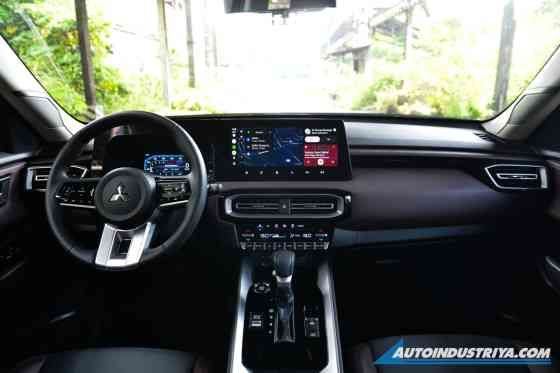
So this comes with the usual bits you’d expect. The steering is electric, so it feels quite light and will likely not offer the feedback expected of hydraulic systems. The parking brake is electronic too, and it has auto brake hold. The cluster is fully digital and does have rather unusual border-like graphics for the tachometer and speedometer. The vehicle also gets this nice touchscreen infotainment, which is very much familiar to me as someone who drives a Navara.
The reason being, is that the Destinator appears to share certain parts with Nissan models. If you’re familiar with the story behind Mitsubishi and Nissan, you’ll know that they do share logistics, components, and suppliers. What changes are things like fonts, graphics, and other functions, but at its core, you can tell it’s the same supplier for the parts, and that’s the case for the digital displays, the rearview, the 360 camera system, and (probably) the smart driver aids like the AEB, adaptive cruise control, blind spot monitor and more. I can tell because it doesn’t have things like the Mitsubishi anti “pedal misapplication” system that became quite the thing after the SUA issue from 10 years ago.
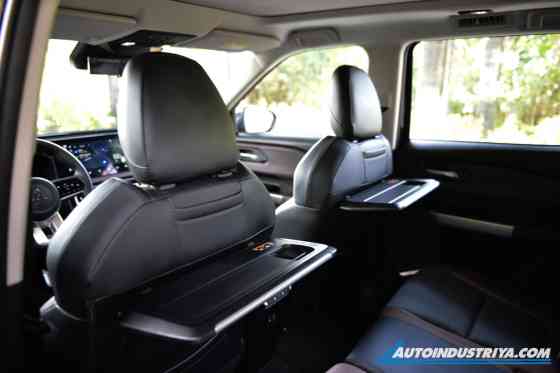
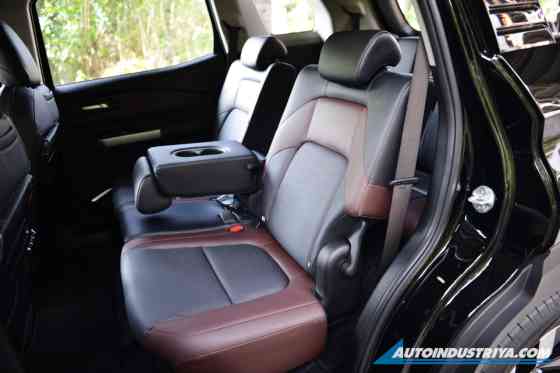
What I really do appreciate is how Mitsubishi configured the middle row and the third row. The space in the third row is really good, even for someone of my size (and weight). The fold and tumble mechanism of the middle row also makes it easy to get in and out. Mitsubishi also cleverly positioned the A/C vents for the third row on the ceiling, as they did with the Xpander; I find this notable because they did it even with the presence of a panoramic glass roof.
The middle row is well done, too. Same deal: good space with overhead A/C vents and A/C controls. The center seat folds down like the Xpander to become an armrest. The sunlight from the glass roof is a nice touch. But the best part is the presence of dual backseat tray tables that have a cupholder each, and can serve as a stand for your mini laptop or tablet. I won’t recommend eating on it if you have to cut something using a spoon or knife because there’s no positive lock (at least that I can see) to prevent it from folding down if you put weight on the surface. Still, a very nice touch that is also present in the GLS version. The GLX doesn’t get the tray tables, sadly.
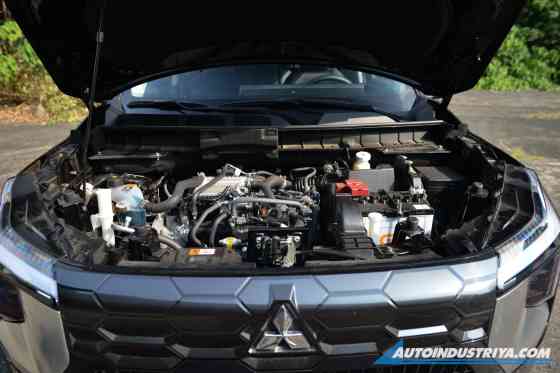
On the road, you would think that this would have even more lackluster acceleration given that it shares the platform of the Xforce and is bigger and heavier too, but it’s not. The Destinator GT -any Destinator variant- feels sprightly and very eager to accelerate. The explanation is simple: this is the first brand new turbo gasoline Mitsubishi I’ve driven since the Lancer Ralliart and Lancer Evolution X a decade and a half ago. Yes, it has been that long.
Of course, this is no performance car, but the engine is no slouch. 163 horsepower and 250 newton meters of torque are very respectable numbers from a dual-injection turbo intercooler (air-water intercooler, mind you) gasoline engine that only has 1.5 liters of displacement. Yes, we know there are 1.5L turbo gas engines that make a bit more, but to be honest, I’d rather they hold back a little rather than chase bigger numbers for the sake of being able to publish bigger numbers. The game here is long-term reliability, and the higher the power or torque out of a little motor will strain it long term. 163 will likely be in the goldilocks zone: just right.
What is somewhat questionable is the use of a CVT. Yes, it’s nice that it has multiple drive modes (including tarmac and gravel), but there have been some concerns over the long-term reliability of the JATCO CVTs (which are also used by Nissan). From what we’ve read, the issues appear to be uncommon and rare. But again, we only get these vehicles for a week at a time, so our take is that the transmission is good, and it makes the management of stop-and-go traffic in the city pretty easy.
That said, fuel economy in urban situations isn’t great, nor is it bad. In heavy traffic (like around 10 km/h average), you’re looking at around 5.5 km/l. When traffic eases up, it settles to around 8.7 km/l (at an average of 20 km/h). On the highway, the fuel economy does go up significantly: over 15.6 km/l if you’re just being sensible and cruising at around 70 km/h.
But what I really like has to be the way the vehicle feels when you drive it. The ride is good; even when driving solo, it doesn’t exhibit the tendency of many seven-seaters to be bouncy. The Destinator is comfortable and smooth. When you demand acceleration, it delivers and does it with minimal throttle or turbo lag (a benefit of the dual injection and the compact air-water intercooler). When you demand handling, that’s also the big surprise: this can corner.
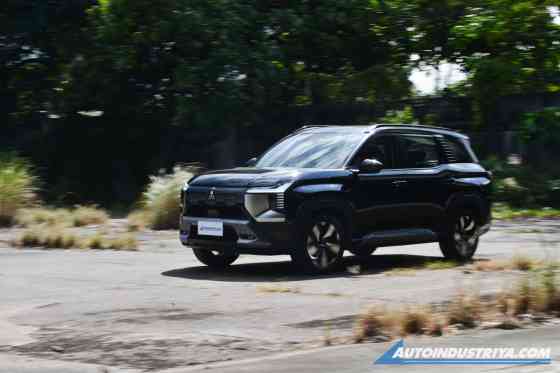
On the bends, it feels good. The brakes have a positive feel about them, and the tires are good. What I’m noticing is that this feels light on its feet when changing direction, even though it’s not an all-wheel drive and even though it has the most cost-effective (read: cheapest to make) type of rear suspension: torsion beam. Despite that, it feels great, and the back end easily rotates into the corner with your steering input. The reason is that this has a torque vectoring system called active yaw control. The one on the Evo series was the super AYC via differential control, but the one in the Destinator is the one via braking. It may be a simpler and more cost-effective (again, cheaper) way to enhance handling, but it really works.
That’s what we’ve missed about Mitsubishi: they like to build cars that we truly enjoy driving. It’s just something about how they tune their suspensions and chassis construction to feel good when driving; like the guys that were key to the enthusiast rally era of Mitsubishi never left and are now calling the shots at R&D. I mean we can’t expect great handling out of models like the Mirage (apart from its lightness) or the L300, but you can definitely feel it with the Triton, Montero Sport, Xforce and even the Xpander. They just feel good. The Destinator is the same, even though it is an FWD-only three-row family SUV.
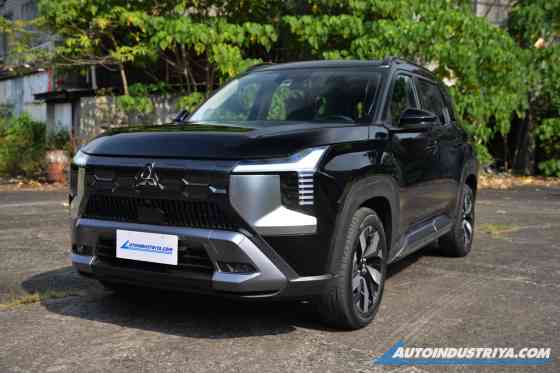
The only thing we would knock the Destinator for is the lack of all-wheel drive options or even a manual mode, especially since Mitsubishi pioneered the INVECS manumatic mode back in the day. To be honest, those are not really critical, but what I can knock them for is the lack of a hybrid system in the Philippines. That will have three effects: 1) make the Destinator coding free at least until 2028, 2) enhance the fuel economy, and 3) drop the price (hopefully) of the GT variant from its current PHP 1.939M SRP. Yes, it’s pricey, but there’s always the GLS variant at about PHP 1.6M, but you lose the sunroof, power tailgate, ADAS, digital rearview, and the neat Yamaha speaker package.
So yeah, the GLS would be my favorite of the line, but whichever version you look at, what we can say is we like the build, the quality, the handling, and power. That last one is crucial, as it means we probably won’t be seeing Destinators awkwardly waiting for a clearing on the side of the road to go up Baguio because the naturally aspirated 1.5 just can’t cut it with a fully loaded cabin.
Yeah, observe how many fully loaded (or overloaded) Avanzas, Velozes, BRVs, Ertigas, XL7s, Livinas, Xpanders, and Xpander Crosses waiting on the shoulder during holiday traffic going up Marcos Highway or Kennon Road to Baguio, and you’ll know what I mean.