2026 Hyundai Kona 1.6 Premium HEV

- Make: Hyundai
- Model: Kona HEV
- Engine: 1.6L DOHC 16V I4 + Electric Motor, Li-ion battery
- Max Power: 141 PS (combined)
- Max Torque: 144 Nm @ 4000 rpm (engine) / 265 Nm (motor)
- Transmission: 6-speed DCT, paddle shift, FWD
- Price as Tested: ₱1,688,000
9/10
9/10
8/10
9/10
7/10
8/10
The underrated funky town performer
For car manufacturers, competing in the hybrid crossover segment is like holding a double-edged sword. You come up with a great product at the right price point, and at the right time, you hit the jackpot. Anything less than that, and you plummet down the order, left squandering for scraps.
That is how competitive it is in the Philippine market these days, and that is the challenge that Hyundai is facing with its HEV lineup, specifically when it decided to bring back the Kona nameplate.
We liked how the previous-generation Kona performed back when Hyundai was yet to become Hyundai Motor Philippines. You rarely see our EIC Vince sing praises in his reviews about how well specced a model is, and how hard it was for him to find anything inherently wrong with it, but he did so in the previous generation Kona. After six years, a new subsidiary and a new generation model with a hybrid, though, it’s now my turn to fill up the evaluation sheet with the Kona.
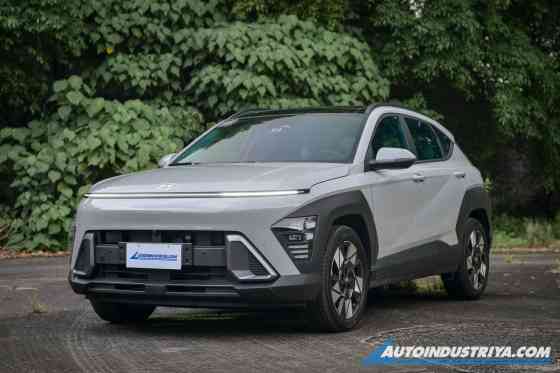
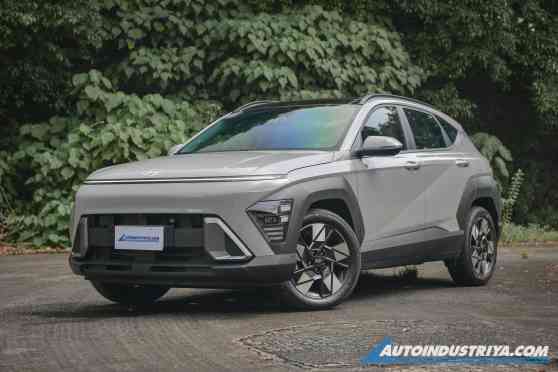
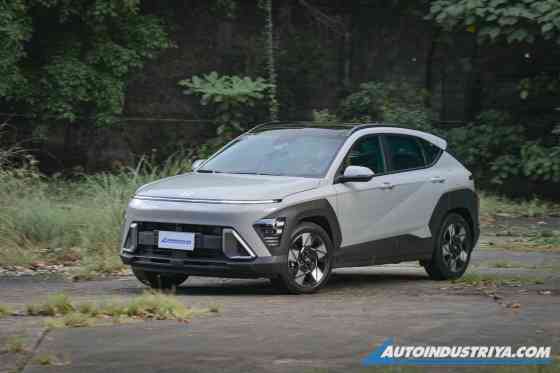
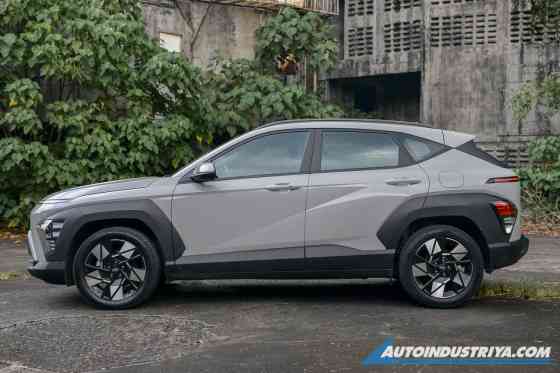
Starting in the looks department, there’s so much to talk about with the new-generation Kona. It’s quite the looker with its futuristic styling treatment. Hyundai came up with a bold exterior design that, while completely new, still has the signature design quirks of the previous generation model.
You can see that with the generous use of black plastic cladding on the body panels, which houses the main headlight and taillight units of the new Kona. An LED light bar runs across the front a la Staria, and the same treatment is done at the back, but with red lenses.
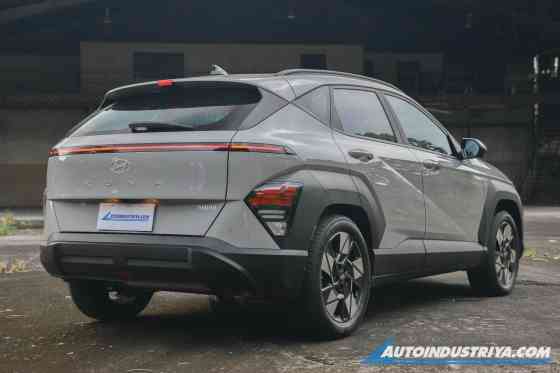
The rest of the body shares some similarities with the current generation Tucson, which seems to have been penned by a designer who paid a lot of attention in their Trigonometry class. You’ll find plenty of triangles at the creases on the side, along with the 18-inch wheels. Couple that with the Cyber Gray color of the unit I tested, and the new Kona won’t look out of place in the set of a Robocop movie.
Likewise, stepping inside gives you plenty of interesting things to see, along with some fresh executions from Hyundai. The wide panoramic screen, the steering wheel, and the column-mounted gear selector appear to be taken from the Tucson and Santa Fe parts bin, but what’s fresh is the brushed aluminum finish on the center console, which reminds me of the home entertainment systems I used to see growing up.
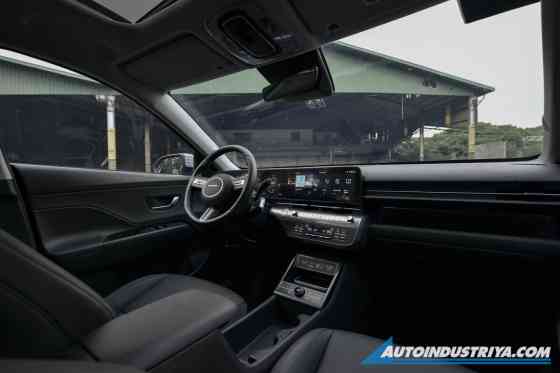
I like how Hyundai made use of knobs, buttons, and toggles to control basic interior functions such as the dual-zone auto climate control and the audio system, and the touchscreen is just two to three submenus deep for more advanced settings. This made the user experience a lot easier, especially for those stepping into modern cars for the first time. Everything looks and feels familiar, except, of course, for the column-mounted gear selector. But after some time, it’s easy to get used to it anyway.
Smartphone connectivity is something I always liked about Hyundai models, as wireless CarPlay and Android Auto always work flawlessly. The dual-mode type C charger in particular is a nice touch, as you can do quick charging for another phone without interrupting the smartphone connection on the screen.
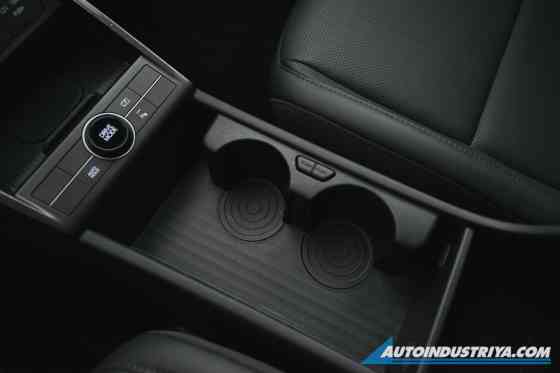
With the center console freed up with the positioning of the gear selector, it’s clear that Hyundai prioritized giving owners generous and modular storage spaces for personal stuff in the Kona. The cupholders even come with spring-loaded rails, which you can tuck in when you don’t have your bottles around. The rest of the cabin has proprietary storage spaces such as cubby holes, seatback pockets, and more cupholders on the door cards.
Space is also great given the size of the Kona. Adults should be content in sitting in any of the outboard seats, as the height is pretty low, so it will feel like sitting in a sedan or a hatchback. Cargo space is around 32 inches long, 40 inches wide, and 31 inches tall with the parcel shelf tucked away. Folding the second row seats increases cargo length to 50 inches, and despite being an HEV, there’s still a donut spare underneath the cargo area. The neat packaging is because the Kona was first designed to be a BEV before it was adapted to accept hybrid powertrains.
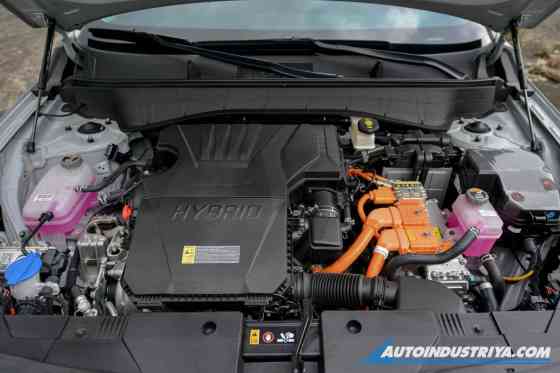
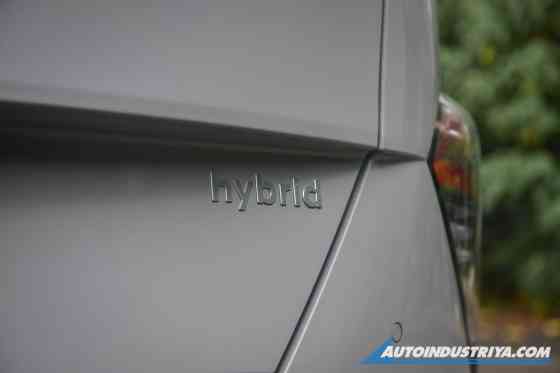
Speaking of which, out goes the 2.0-liter, four cylinder of the old one, and in goes the G4LL - a 1.6-liter Smartstream G GDI hybrid powertrain, which delivers a combined system power of 141 PS and 265 Nm of torque paired to a 6-speed dual clutch transmission.
Since the Kona comes from Hyundai’s Ulsan plant in South Korea, it has high standards for build quality, given the lack of rattles and squeaks inside. Couple that with the low seating position and the comfort-tuned suspension, and the Kona is indeed a pleasant thing to drive daily. The ride comfort is plush, and there’s a fair bit of lean when you take on corners at speed, but nothing really feels unsettling. It remains composed on dips and bumps, and you barely hear the engine when cruising.
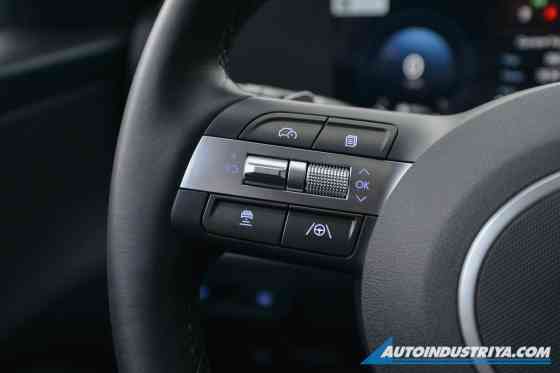
You’re spoiled with the generous amount of sensors and cameras around, so the Kona is highly maneuverable in tight spaces and navigating busy streets. Given the reputation of dual clutch transmissions for being jerky at low speeds, the initial getaway is surprisingly smooth onboard the Kona. I’m not quite sure if they used any kind of wizardry, but I think they nailed the seamless transition from low-speed EV mode to hybrid mode when accelerating from a stop.
Speaking of which, the acceleration's also linear, so it feels more ICE than EV, and you can feel some subtle torque cuts when the transmission moves into a higher gear. Deceleration also feels familiar to those coming off ICE vehicles, as the regenerative braking is not as strong as other hybrids equipped with one-pedal modes.
What really surprised me the most is how fuel-efficient the Kona HEV is. My time with the crossover involved expressway runs and city trips going back and forth to the office for a week, and not once did I ever try to do hypermiling. In the city, I was able to log 20.8 km/l on an average speed of 17 km/h, but the highway number is an impressive 26.4 km/l at a 64 km/h average speed.
At one point, I even managed to do 29.4 km/l on my way back to Manila. The low drag body could be a factor, but the rest of the work was done by the HEV system. What’s even more impressive is that despite racking up more than 400 kilometers, the fuel gauge says I only managed to use half of the Kona’s small 38-liter fuel tank.
Overall, the new Kona is really easy to drive, it's comfortable, impressively frugal, and even though it looks futuristic, it doesn't require a PhD in rocket science to familiarize yourself quickly with the car.
At PHP 1,688,000, you’d be thinking you’re better off with a bigger vehicle from a Chinese brand, but I’d respectfully disagree. For a top-of-the-line hybrid crossover from an established brand, it actually undercuts cars like the Corolla Cross GR-S and the HR-V e:HEV by a lot. But if you ask me, I'd be just as happy getting the GLS variant of this for just over PHP 1.5 million.
With that, I get smaller wheels, lose the sunroof, but the upside is that I won’t have to deal with something I didn’t quite like with the Kona. It’s not something inherently wrong with the car, but it’s more of a personal preference. That is when you can't save your preferred settings, which helps activate or turn off the Hyundai Smartsense.
Personally, the lane keep assist and reverse parking collision avoidance are something I prefer to turn off as it gets in the way of my natural driving. So every time I set out for a drive, turning those off is an extra step that I have to do. Perhaps I should just treat the ADAS setting time as pre-flight checks then, right?
But much like Vince with the previous-generation Kona, I found it hard to find fault with the way the new Kona is packaged, designed, and engineered. It’s a model that Hyundai needs to push since it deserves to be in the spotlight for those out in the market for a hybrid crossover.