2024 Honda City RS Hatchback 1.5L CVT

- Make: Honda
- Model: City RS Hatchback 1.5L CVT
- Engine: 1.5L DOHC 16V Inline-4 i-VTEC
- Max Power: 121 PS @ 6600 rpm
- Max Torque: 145 Nm @ 4300 rpm
- Transmission: CVT, manual mode, FWD
- Price as Tested: ₱1,189,000
8/10
8/10
9/10
8/10
7/10
8/10
Daily fun and function
Everyone wants a crossover nowadays, and we totally understand why.
You’re spoiled with lots of options on size, cargo versatility, fuel efficiency, the extra ride height. And there are now some that you can buy for under PHP 1 million pesos. But sometimes for us in the automotive media, it can get tiring to review vehicles in the same segment over and over again. In tagalog, it’s called umay.
So when the new Honda City RS Hatchback was delivered to the office, it was definitely the palate cleanser I needed.
It’s not too long ago that subcompact hatchbacks like these were considered the ideal daily driver in the metro. Even more so for college kids. They were small, economical, and it’s very easy to mod and put your personal touch in. A lowering spring and a nice aftermarket set of wheels often do the trick in making you one of the coolest guys/gals in the school parking lot.
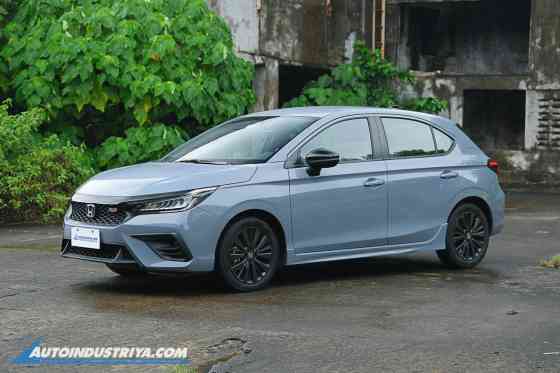
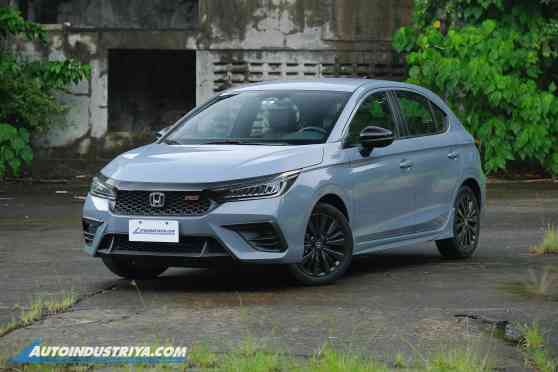
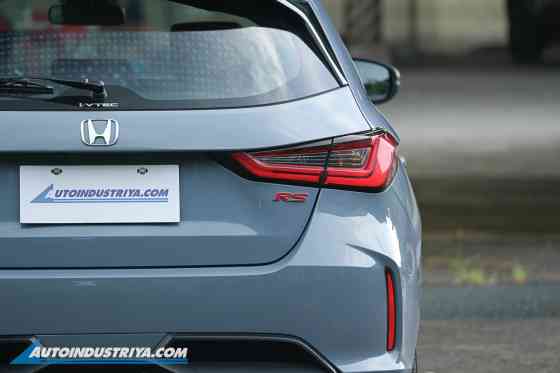
The same can be said with this new City hatch. It’s been in the market since 2021, but this year it’s been given a minor exterior update that mirrors that of its sedan counterpart. The new RS treatment made the leading edge of the front bumper longer, while the grille has a bigger opening to feed more air through the radiator. Also, there’s a new design for the RS badge – it’s the same one you’ll find on the new CR-V RS e:HEV.
I like the new Sonic Gray color as the City RS looks very youthful, very boy racer with this paint scheme. Honda also updated the rear bumper design with the vertical slats on the faux diffuser, and it gets extra style points on the side with the added side skirts. However, there are some things I wish Honda could have done more, especially on the wheels and the exhaust tip.
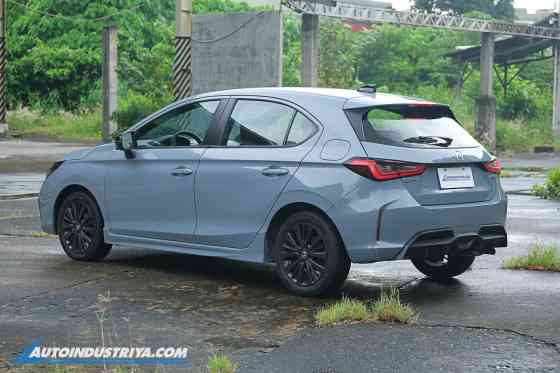
The 16-inch wheels have a new design. But because of the skirt, the wheel now tucks more inside the wheel wells and makes the car look narrower than usual. It’s not as visually appealing compared to the wheels being aligned with the fenders. The exhaust, on the other hand, could make do with an added chrome tip for a nice finish, just so it does not look like it was pulled from a base model. Simply put, if I had the City hatch as my own, those two would be the first ones to go.
Honda didn’t change a thing with the dashboard design when you step inside the new City hatch, and that’s perfectly fine. Even for a three-year-old design, it still looks fresh and the materials, while mostly hard plastics, still have a nice feel to it. Ergonomics-wise, I really like how the controls are right where they should be. Even as a regional model (unlike the Civic and CR-V) the City still has that “simplicity and something” concept which makes use of minimalism in the design but with maximum functionality in mind.
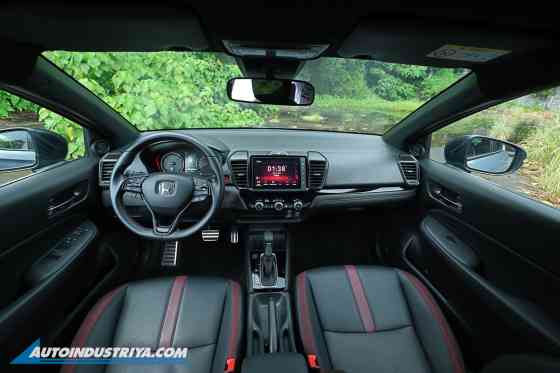
What they did update was the instrument cluster for it to feature the Honda Sensing suite, along with the added buttons on the steering wheel. The City hatch now shares the same gauges as that of the non-turbo HR-V S. There’s also more leather now on the seats, but it still features the very Deadpool-like red trims and the red stitching. Also, a minor update was done on the 9-inch infotainment touchscreen as it now has wireless Apple CarPlay and Android Auto.
While those features are basically the same you’ll get with the sedan RS, where the hatch stands out is when you pop the tailgate open. That’s because the City hatch kept the ULTR seats of the discontinued Jazz, making it more versatile for carrying your stuff.
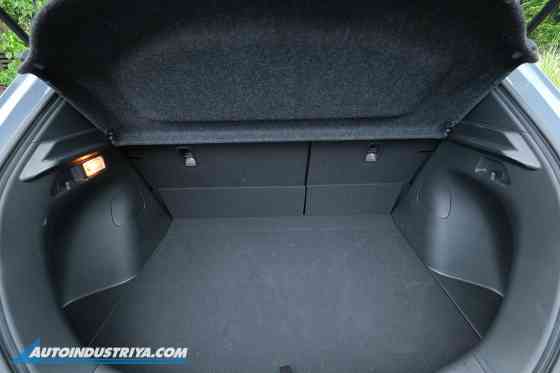
In its standard configuration, you get 27 inches of cargo length, 51 inches max width, and 35 inches between the wheel wells. When you fold down the rear seats, you get up to 60 inches of flat cargo area.
For tall items, the second-row seat cushions can be moved upwards so you can utilize the height from the floor to the hatch’s ceiling. And when you need to relax inside, the front seat can be reclined fully (minus the headrest) to align with the rear seat cushions – basically turning the City’s interior into a sofa bed.
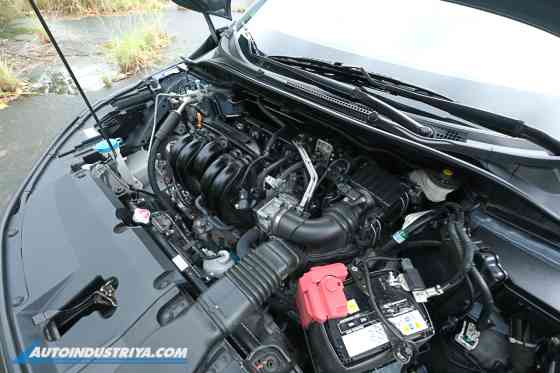
Powering the City hatch is still the familiar L15ZF – the 1.5-liter, naturally aspirated i-VTEC motor that’s shared with the BR-V, and the non-turbo variant of the HR-V. It makes 121 PS and 145 Nm of torque and is mated to a CVT. While the 1.5-liter mill can feel a bit sluggish with the BR-V and the HR-V, it’s a different story when it’s with the City hatch.
The power and torque are a great match for the size of the vehicle. It’s peppy in town, and really efficient on the expressways. I can easily do 11 km/l in my daily commute to the office, and 22 km/l is doable even when you’re always at the speed limit on the highways. If you’re the type of driver who just cruises along SLEX or NLEX between 80-90 km/h, then don’t be surprised if the gauge will read north of 25 km/l.
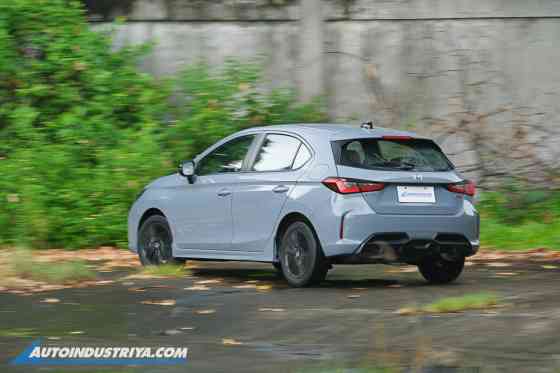
It’s not just fuel economy where the City hatch shines bright, but also when it comes to driving dynamics. Since it’s much lower than a crossover, it’s more eager to corner and stay flat when turning on winding roads. In the urban setting, there’s not much road noise inside as it looks like the City has more sound deadening compared to other small crossovers in its price range.
In terms of comfort, the rear suspension is slightly firmer than the sedan. But because they have the same wheelbase, you can expect a subcompact sedan level of comfort, unlike most hatchbacks that are inherently bouncy because of the short wheelbase.
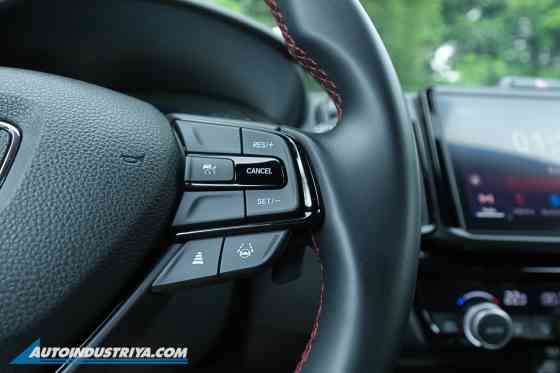
And of course, the cherry on top is the Honda Sensing suite that allows you to cruise along the expressways effortlessly. I’ve said it before and will say it again, Honda has one of the least intrusive and smoothest-operating ADAS I’ve tested so far.
Overall, I had such an enjoyable time with the City hatchback. It’s given me the features I need for daily driving, along with the driving fun behind the wheel with its refinement. Mechanically, the only thing I would really want for the City hatch are rear disc brakes and a manual transmission option. Perhaps those two things are the only ones keeping us from seeing the City, or more modern Hondas in general, on the race track being driven by car enthusiasts.
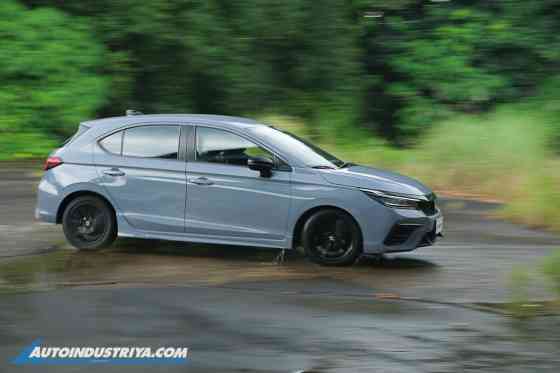
In its segment, I think the City hatchback is still the one to beat. The Yaris hatch is gone. The Mazda2, while it’s fun to drive, lacks the interior versatility the City has. Not to mention the space. Then there’s the Swift which is good but lacks power. The newer one is the MG3 hatchback with a hybrid, but the City can match the efficiency even as a non-hybrid at least in highway driving.
For the price of PHP 1.189 million, I don’t really see myself that overcharged with the features, refinement, efficiency, driving dynamics, and versatility the City hatchback brings to the table. It’s just that for that amount of money (or even less), you can already get yourself a small crossover that comes with more or less the same features, but with the extra ground clearance.
That one factor has been the main reason why everyone wants small crossovers over hatchbacks nowadays. But what people don’t know is that the running costs of a hatchback are way cheaper than owning a small crossover. Maybe in the first few years, you won’t feel it, but over time it adds up. Fuel is one; lighter is better for fuel efficiency, and a lighter hatchback will be more efficient than a similar crossover on the same platform if all things (engine and transmission) are equal. When it’s time to change tires, you’ll know that a crossover’s tires can cost almost twice as expensive compared to changing a hatchback’s set.
Really, it’s just bad urban road conditions and flooding that keep us from seeing more City hatchbacks out there. I’ve recently been to Malaysia where they have much better urban roads and saw that low-riding vehicles such as the City hatchback are still thriving. So if those are really not an issue for you in your area, then I like to think the driving dynamics, versatility, and ease of use would still gravitate you towards owning a hatchback like the City RS.