Toyota hasn't forgotten about internal combustion engines (and diesel) yet

Toyota developing new engines, upgraded diesels
When you're attending a foreign trade show like the Japan Mobility Show, it's easy to feel left out if you're a car enthusiast.
The reason is that automakers are definitely leaning on very forward-looking technologies that may be a reality in their already advanced home markets, but definitely not relevant in ours. Sure, learning about BEV technology is great and the potential of hydrogen fuel cells is interesting, but widespread relevance for BEV us only starting up, and the viability of FCEV is at least a decade away for the Philippines.
Toyota, while also heavily invested in both, is saying different: they still have ICE in their portfolio, and are still working on improving their designs.
During a conference at a venue adjacent to the ongoing 2025 Japan Mobility Show, we caught up with several Toyota executives involved with different drive systems and safety programs. While learning about their new BEV and FCEV designs was interesting, many of us were very curious about the two engines on display, and Toyota's Powertrains Company head, Takashi Uehara, was on hand to answer our questions.
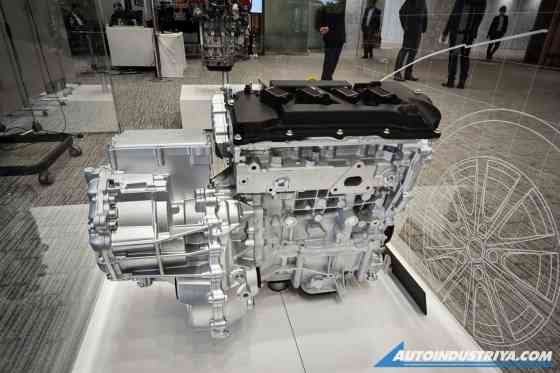
The first power unit we saw was something he called the N15, and it is a 1.5-liter four-cylinder hybrid. It is not to be confused with the M15 that Toyota is currently using, as the M15 is a three-cylinder, not a four.
The set-up of the power unit itself reminds me of the dedicated hybrid transmissions (DHT), and Toyota is adopting the same style because of its advantage of being compact and modular. That was the whole idea in the first place, so as to be able to fit the unit inside existing platforms.
While still a prototype in development, Uehara stated that the engine develops about 70 kW (95 PS) and about 120 Nm of torque. The drive motor in the DHT produces about 100 kW and is paired with a new lithium-ion battery pack for future hybrids. The DHT itself uses an eCVT, and the power unit shown will be used in the upcoming Corolla once they progress from the concept currently shown at JMS.
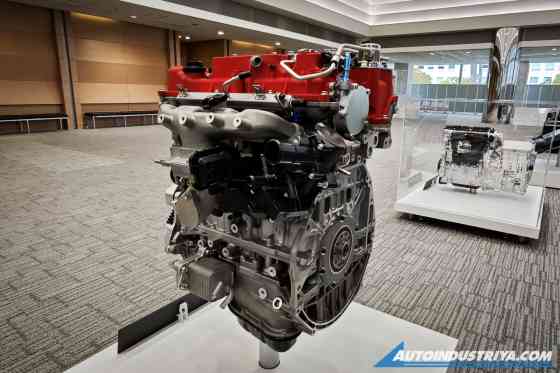
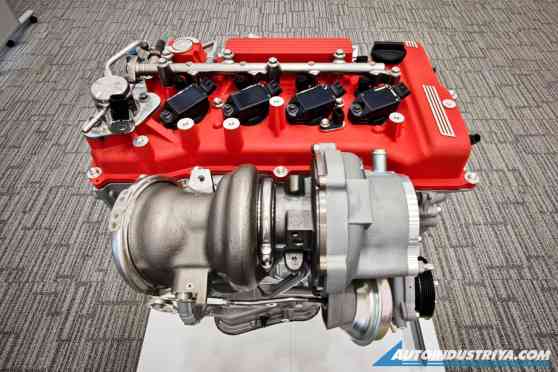
The second engine is a new one too, and it’s the G20. This power unit is meant for high-performance applications, as it is a 2.0L turbocharged gasoline engine that they are currently running in a GR Yaris in the Super Taikyu class in Japan, being driven by Morizo (the alter ego of Toyota chairman Akio Toyoda).
The very compact four-cylinder 2.0L turbo runs on 100 octane fuel, has a high-mount turbocharger (for easier servicing), and a lot of other goodies to make it perform. And perform it can. Uehara says the engine can generate upwards of 400 PS.
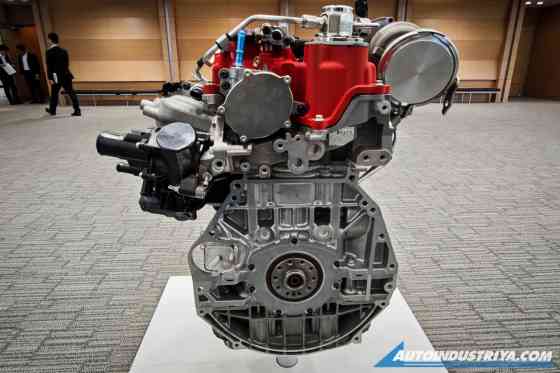
But all this development is focused on gasoline, so I asked the powertrain division head on what will become of our beloved diesel engines, and he said not to worry.
“We have not given up on diesel,” said Uehara.
He opined that diesel fuel isn’t going away anytime soon for markets that still depend on the fuel and need the torque at low RPMs, but he did mention that there is a challenge with it: emissions. Engineering a modern diesel engine to meet stricter emissions standards will be. The difficult part, and he says that they will need complex and expensive exhaust systems to enable diesels to do that.
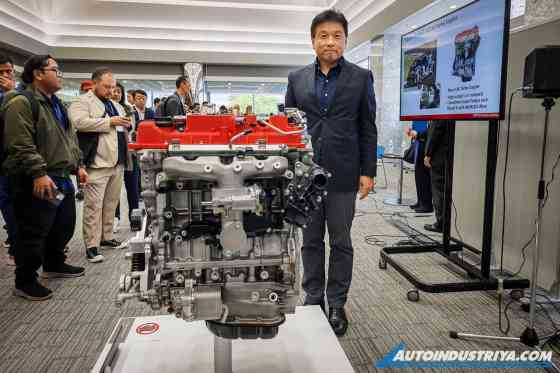
According to Uehara, however, the key to diesel’s future will be electrification and hybridization. By combining hybrid technology with a modern diesel engine, they can reduce emissions without having to make such a complex exhaust system. He described it as a somewhat of a meet-in-the-middle compromise by using both
We hope his department does get the breakthroughs they need, as ICE will still be relevant in many markets in the future. Besides, that’s the whole idea: To You, Toyota.