San Juanico Bridge full repair to cost PHP 5.9 billion

Bridge is currently operating under limited load limit
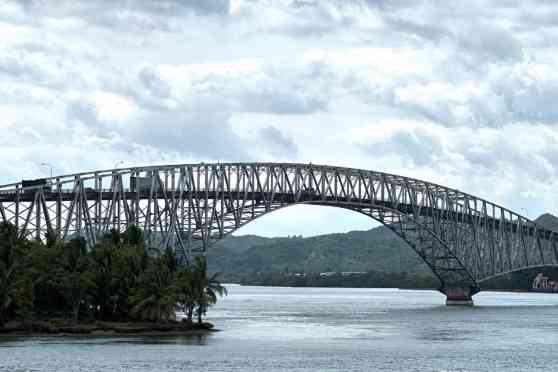
Despite the announcement of a second San Juanico Bridge by the Department of Public Works and Highways (DPWH) that’s set to finish in 2028, the existing 2.16 kilometer bridge connecting the islands of Samar and Leyte currently needs immediate repair and rehabilitation.
Since May 15, a three-ton load limit has been imposed on the bridge, barring trucks and buses from entering. This posts logistical challenges in the movement of goods, especially in the provinces of Samar and Leyte.
According to Eastern Visayas Regional Development Council (RDC) vice chair and Department of Economy, Planning and Development Regional Director Meylene Rosales, the full repair of San Juanico Bridge will cost around PHP 5.89 billion.
Over the next two years, PHP 1.96 billion is needed for dry shotcrete application, PHP 1.62 billion for foundation retrofitting, PHP 1.09 billion for girder retrofitting, PHP 437.55 million for box and truss, PHP 345.57 million for replacement of bearing, PHP 225.72 million for painting works, PHP 164.08 million for catwalks, and PHP 52.83 million for joint expansion. This amount was endorsed by the Regional Development Council (RDC) as requested by the Department of Public Works and Highways (DPWH).
The RDC is seeking an immediate release of PHP500 million calamity funds, as no significant budget was appropriated by the DPWH this year for repair of the iconic bridge. With San Juanico Bridge being a vital artery in the country, the RDC believes the current issues of the San Juanico Bridge can be treated as a calamity, thus the move to use calamity funds. The RDC has also passed a resolution to include the estimated budget in the 2026 and 2027 GAA of the DPWH to ensure that rehab works will finish within two years.
For now, several ports in the Leyte and Samar islands have already been identified as a temporary roll-on, roll-off route for cargo trucks that are currently banned from entering the San Juanico Bridge. The DPWH, on the other hand, is already finalizing plans and cost estimates, along with finishing construction methods that do not require closure of the bridge itself.