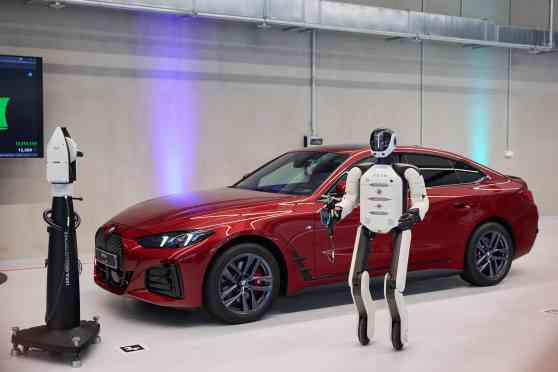
BMW assigns humanoid robots in its production line in Germany

BMW rolls out humanoid robots in its factory in Germany
If you’ve seen the Terminator movies, you know the drill: humans versus Artificial Intelligence (AI) and killer robots taking over the world.
However, there's no need to panic because Germany’s taking a page from sci-fi, but for GOOD. They’re using AI and humanoid robots (the friendly kind) to help build cars, proving that sometimes, the future of tech isn’t about world domination, but about world-class engineering.
German automaker BMW recently announced it will be integrating “Physical AI” into its production lines, allowing intelligent systems like humanoid robots to work hand-in-hand with humans on the factory floor.
“Digitalization improves the competitiveness of our production – here in Europe and worldwide. The symbiosis of engineering expertise and artificial intelligence opens up entirely new possibilities in production,” said Milan Nedeljković, Member of the Board of Management of BMW AG, Production.
Last year, BMW Group ran a successful pilot project using humanoid robots at its Spartanburg plant in the U.S. The lessons learned are now helping the company expand and refine its Physical AI applications for broader use.
BMW adds that it is using AI throughout its factories to make production smarter and more efficient. From digital twins that simulate the factory to AI tools that check quality and manage logistics, intelligent systems are involved in nearly every step of making a car. To make this work smoothly, BMW has created a single, unified data platform so all factory information is consistent and accessible. This allows AI “digital assistants” to take on more complex tasks, learn on the job, and eventually work alongside humans in real production.
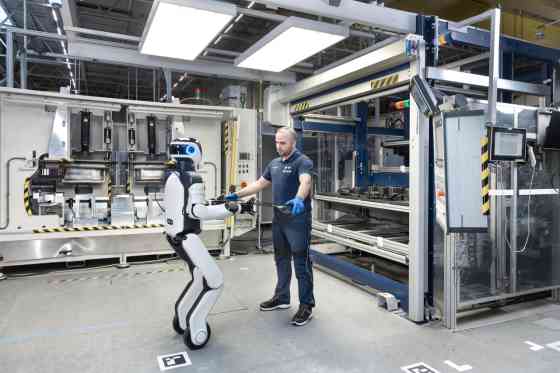
These human-like robots are especially useful for repetitive, physically demanding, or safety-critical tasks, helping to reduce strain on employees while improving overall efficiency. Early pilot projects, like the one at BMW’s Spartanburg plant in the U.S., have already shown that humanoid robots can handle precise, repetitive work like moving thousands of components accurately over long shifts without disrupting the production line.
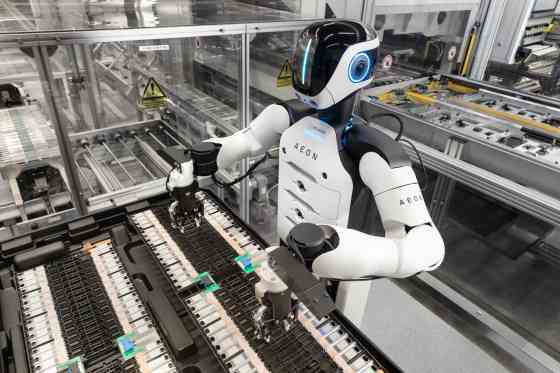
BMW is also building expertise in this field through its new Center of Competence for Physical AI. By working closely with technology partners, the company tests robots in real-world factory conditions, gradually scaling from lab simulations to full pilot projects. For example, the AEON robot is currently being trialed at the Leipzig plant in Europe, focusing on battery assembly and component manufacturing. These efforts are helping BMW combine AI, robotics, and human workers into a more flexible and future-ready production system.